BugendaiTech at TDX26: What We Saw, What We Spoke, and What It Means for Enterprise AI
Event On 15 April 2026
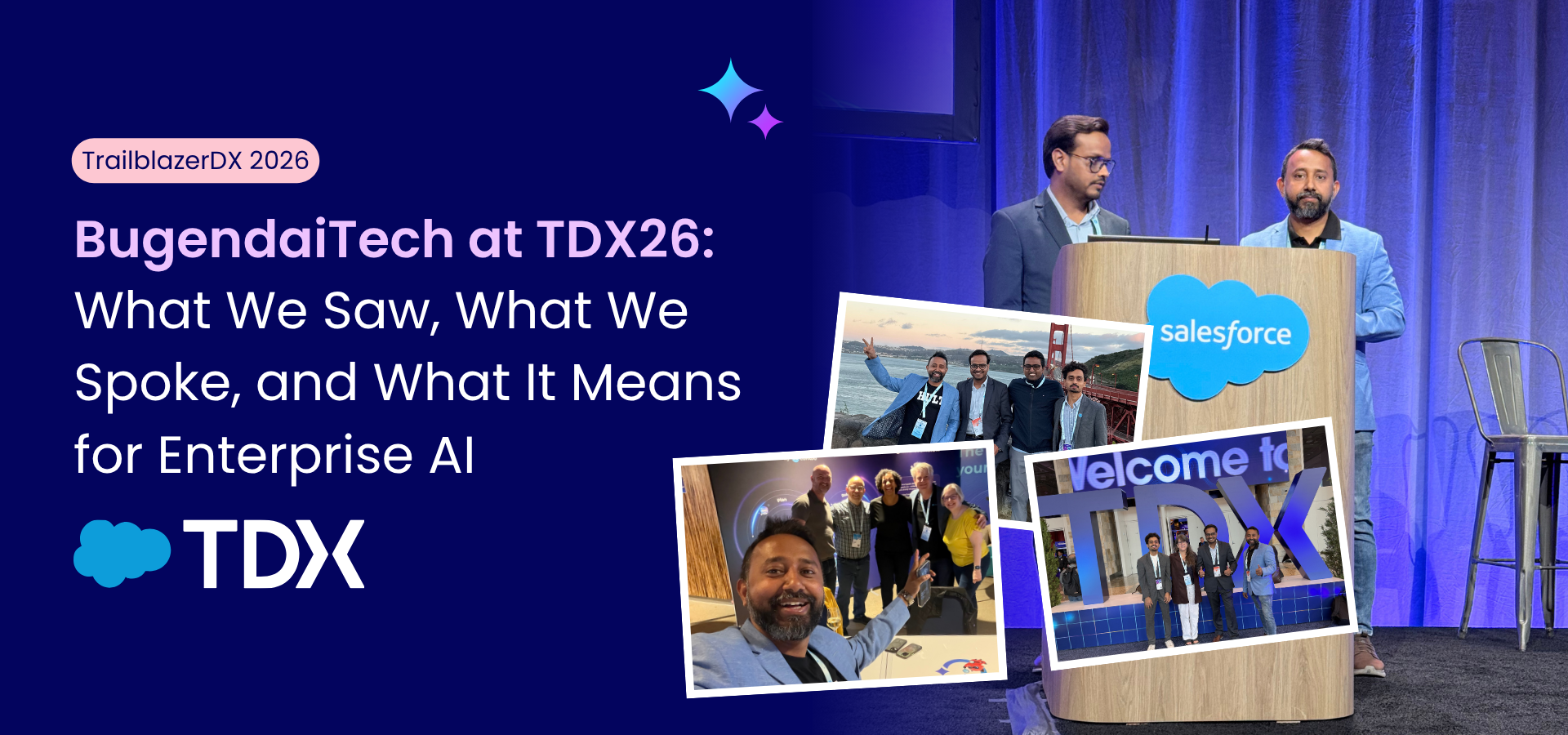
TrailblazerDX 2026 (#TDX26), Salesforce’s flagship developer conference, wrapped up on April 15-16 at Moscone West, San Francisco. For BugendaiTech, this wasn’t just another conference on the calendar. Our CEO, Roushan Kumar, and Chief Technical Architect & Delivery Director, Aman Sahu, took the stage as speakers, while Wendy, Chandan Ghosh, and Rohan Kalbhor attended across both days, absorbing 400+ sessions, live product announcements, and a wave of architectural shifts that will define how enterprises build on Salesforce for the next decade.
Here is what happened, and why it matters to you.
1. Salesforce Declared the Biggest Architectural Shift in 25 Years and It Changes How We Build
The headline announcement at TDX26 was Salesforce Headless 360, a fundamental reimagining of the entire platform. In Salesforce’s own words: everything is now an API, an MCP tool, or a CLI command. Agents and developers no longer need to navigate a browser or click through UIs to access Salesforce’s full power.
Salesforce co-founder Parker Harris framed it plainly last month: “Why should you ever log into Salesforce again?” At TDX26, that question became product reality.
What this means in practice:
- 60+ new MCP (Model Context Protocol) tools giving coding agents live, complete access to your entire Salesforce platform - data, workflows, and business logic, from any external environment
- 30+ preconfigured coding skills compatible with Claude Code, Cursor, Codex, and Windsurf
This is not an incremental update. This is Salesforce rebuilding its foundation for a world where agents and humans work side by side. For enterprises waiting for a clear signal on where to invest in AI architecture, this is it.
2. Agentforce Vibes 2.0 and Multi-Model Support Redefine Developer Speed
One of the most talked-about live demonstrations at TDX26 was Agentforce Vibes 2.0, an AI-powered development environment that now supports multiple models, including Claude Sonnet and GPT-5, as well as Salesforce’s own models.
What sets it apart is full org awareness. Vibes 2.0 understands your organization’s metadata, schema, and existing code patterns from the moment you open it. Developers can describe what they want in natural language and receive production-grade code across Apex, LWC, and React, without switching context or tools.
The free Developer Edition upgrade announced at TDX26 makes this even more accessible: every Developer Edition org now includes the Agentforce Vibes IDE, Claude Sonnet 4.5 as the default coding model, and Salesforce Hosted MCP Servers, at no cost.
For development teams already using AI coding tools, Vibes 2.0 is not a replacement for your workflow. It is Salesforce finally meeting you inside it.
3. Agent Script Goes Open Source - a Governance Milestone for Enterprise AI
Perhaps the most architecturally significant announcement of TDX26 was the open-sourcing of Agent Script, a structured, strongly typed agent definition language that gives developers precise control over when an AI agent uses LLM reasoning and when it follows deterministic business logic.
The full language specification, grammar, parser, and compiler are now available publicly at github.com/salesforce/agentscript.
Why does this matter? Because one of the core challenges in enterprise AI deployment is governance. How do you ensure an agent behaves predictably across edge cases? How do you define guardrails that legal, compliance, and security teams can stand behind? Agent Script provides the layer that makes AI agents auditable, controllable, and enterprise-ready.
Paired with the ADLC (Agent Development Life Cycle) Skills, which close the full loop from local authoring through LLM-powered safety reviews, CI/CD deployment, and production observability, enterprise teams now have an end-to-end framework for building agents that are not just functional but trustworthy.
4. BugendaiTech on Stage: Secure AI Integrations with Zero Trust and MCP
BugendaiTech CEO Mr. Roushan Kumar and Chief Technical Architect Mr. Aman Sahu delivered a session that addressed a question every enterprise AI team is quietly wrestling with, and not enough people are asking out loud.
Session: Secure AI Integrations with Zero Trust and MCP
- April 15, 2026 | 3:30 PM - 3:50 PM | Theater 1, Campground · Level 1
- April 16, 2026 | 4:00 PM - 4:20 PM | Theater 5 · Level 3
The session was delivered twice across both conference days to full rooms.
The central argument: the race to deploy AI agents is outpacing most organizations’ security architecture. MCP is one of the most powerful shifts in how AI interacts with enterprise systems, but it also introduces new attack surfaces that most teams are not yet designing for. Building fast on Salesforce’s new headless infrastructure without thinking through Zero Trust boundaries is building fast on a shaky foundation.
Roushan and Aman walked attendees through four areas:

5. The AgentExchange Ecosystem, and What It Signals for the Year Ahead
TDX26 also marked the formal unification of AppExchange, Slack Marketplace, and the Agentforce ecosystem into a single platform: AgentExchange.
The numbers tell the scale:
- 13,600+ registered apps, agents, and MCP servers
- 10,000 Salesforce apps, 2,600+ Slack apps, and 1,000+ Agentforce agents and tools
- Semantic search powered by Data 360, matching solutions to business intent, not just keywords
- A $50 million AgentExchange Builders Initiative to support partners building and scaling on the platform
Real-world results shared at TDX26 illustrated the business impact: Notion cut its average sales cycle from four months to three weeks after listing. DocuSign processed 200+ private offers in Q4 2025 with 60% faster time to signature. MeshMesh closed its first Fortune 500 customer six weeks after listing.
Meanwhile, AI agents on Slack have grown 300% since January 2026, a signal of where enterprise workflows are already heading, regardless of what organizations have formally planned.
For BugendaiTech clients and partners, the practical read is this: the tools, the marketplace, and the delivery framework are now aligned. The teams that move from experimentation to a governed, production-grade Agentforce deployment in 2026 will hold a significant advantage. We are here to help you be one of them.
Our Team Was There

The insights from TDX26 are already shaping how we think about architecture, delivery, and security for our clients. If you want to understand what these announcements mean for your Salesforce roadmap, or if you missed the session on Secure AI Integrations with Zero Trust and MCP and want to continue that conversation, reach out. We would love to talk.
BugendaiTech is a Salesforce partner specializing in enterprise architecture, AI delivery, and secure platform integrations. Learn more at bugendaitech.com