How to Build Powerful AI-First Digital Experiences That Drive Results in 2026
Published on: 20 May 2026
Author: Jyoti
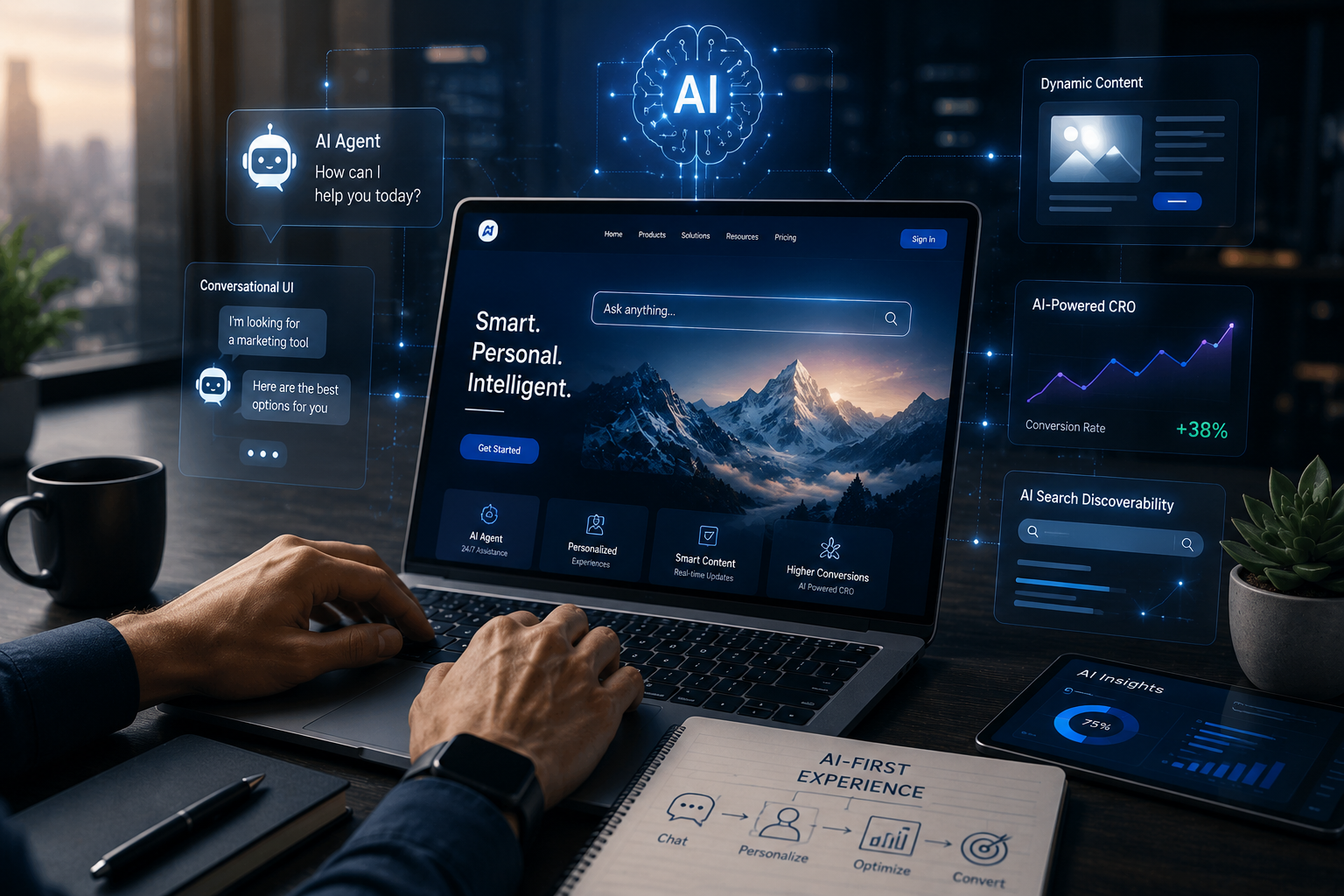
Artificial Intelligence is no longer an “extra feature” in digital products. In 2026, businesses are redesigning entire websites, customer journeys, and conversion strategies around AI-first experiences. From conversational interfaces and AI agents to adaptive content and AI search optimization, the digital landscape is rapidly shifting toward intelligent, predictive, and personalized interactions.
The biggest transformation is not just technological; it is behavioral. Users now expect websites to respond like humans, understand intent instantly, personalize experiences dynamically, and deliver answers instead of forcing navigation.
At recent announcements during Google I/O 2026, Google introduced conversational AI-powered search experiences, AI agents, adaptive interfaces, and multimodal interactions, signaling a major evolution in how users discover and engage with digital platforms.
For brands, this means one thing:
Traditional websites are becoming AI-driven experience platforms.
What Does “AI-First Digital Experience” Mean?
An AI-first digital experience is a website or platform designed around intelligence, personalization, automation, and conversational interaction from the beginning, not added later as a plugin or chatbot.
Instead of static user journeys, AI-first platforms create adaptive journeys based on:
| • User intent | • Behavior patterns |
| • Context | • Real-time interactions |
| • Predictive analytics | • Search intent signals |
Modern AI-first websites focus on:

According to industry research, AI-powered search interfaces and agentic AI are rapidly becoming the new standard for customer engagement and enterprise operations.
1. Conversational UI & AI Agents
The era of traditional navigation-heavy websites is fading.
Users increasingly prefer asking questions rather than browsing menus. This is why conversational UI has become one of the biggest UX trends in 2026.

What is Conversational UI?
Conversational UI allows users to interact with websites using natural language, through chat, voice, or AI-driven interactions.
Examples include:
- AI customer support assistants
- AI shopping advisors
- AI onboarding agents
- Voice-enabled search
- AI travel planners
- AI healthcare assistants
Google’s latest AI-driven search updates also show that conversational interfaces are becoming central to digital discovery.
Real-World Example
E-commerce AI Shopping Assistant
Imagine a fashion e-commerce website.
Instead of filtering products manually, users can type:
“Show me office wear under ₹3000 for summer.”
The AI agent instantly:
- Understands intent
- Recommends products
- Suggests matching accessories
- Personalizes recommendations
- Answers sizing questions
- Completes checkout assistance
This creates:
- Faster decision-making
- Higher engagement
- Better customer satisfaction
- Increased conversions
According to conversational AI industry research, enterprises are increasingly investing in AI assistants for customer engagement, personalization, and omnichannel experiences.
Why Conversational UX Matters in 2026

AI agents are also reshaping B2B customer journeys, where buyers often interact with AI-generated responses before visiting websites directly.
2. Dynamic Website Content Powered by AI
Static websites are becoming obsolete.
Modern AI-first websites now adapt content dynamically based on:
- User behavior
- Location
- Device
- Previous interactions
- Purchase history
- Search intent
- Session behavior
This is known as dynamic AI-driven content personalization.
Example: AI-Powered SaaS Website
A SaaS website can dynamically change:
- Headlines
- CTAs
- Pricing sections
- Testimonials
- Product recommendations
- Case studies
based on visitor type.
Example Scenario

This level of adaptive personalization dramatically improves engagement and conversion performance.
Research in AI optimization highlights how machine learning and predictive systems are helping brands automate personalization and improve user engagement in real time.
3. AI-Based CRO (Conversion Rate Optimization) Strategies
Traditional CRO relied heavily on:
- Manual A/B testing
- Heatmaps
- Static funnel analysis
AI-based CRO is fundamentally different.
Modern AI systems can:
- Predict user intent
- Identify drop-off risks
- Optimize layouts automatically
- Personalize CTAs
- Recommend best-performing content
- Adapt user flows in real time
Smart Landing Page Optimization
An AI-powered landing page can:
- Detect visitor behavior patterns
- Change CTA copy dynamically
- Rearrange content blocks
- Adjust forms based on user intent
- Recommend personalized offers
For example:
- Returning users may see “Continue Your Trial”
- New users may see “Book a Demo”
- Enterprise visitors may see “Talk to Sales”
AI continuously learns which variations perform best.
Predictive Personalization
One of the strongest AI CRO strategies in 2026 is predictive personalization.
AI systems analyze:
- Browsing behavior
- Scroll depth
- Interaction patterns
- Time spent
- Search intent
to predict:
- Purchase likelihood
- Churn probability
- Content preferences
- Conversion probability
This helps brands deliver highly targeted experiences.
According to AI optimization research, AI-driven experimentation can outperform traditional A/B testing by continuously learning and reallocating traffic automatically.
4. Designing Websites for AI Search Discoverability
Search is undergoing its biggest transformation in decades.
Users are now discovering content through:

This means websites must now optimize not only for humans, but also for AI systems.
The Rise of AI Search Optimization
Traditional SEO focused on:
- Keywords
- Backlinks
- Meta tags
- Rankings
AI search optimization focuses on:
- Semantic relevance
- Structured content
- Contextual authority
- Conversational intent
- Trustworthiness
- Machine readability
Research shows that AI-generated search experiences retrieve and prioritize information differently than traditional search engines.
Key Strategies for AI Search Discoverability

1. Create Conversational Content
Content should answer:
| • Questions | • Intent | • User problems |
Instead of only targeting keywords.
Example:
Instead of:
“Best CRM Software”
Use:
“Which CRM software is best for small businesses in 2026?”
AI systems prefer natural language relevance.
2. Use Structured Content Architecture
AI systems understand:
| • Clear headings | • Semantic HTML |
| • FAQ structures | • Entity relationships |
better than cluttered content.
3. Build Topical Authority
AI engines prioritize trusted and authoritative sources.
Brands must:
| • Publish expert-level content | • Create topic clusters |
| • Build consistent authority | • Demonstrate expertise |
4. Optimize for AI Crawlers
AI discoverability increasingly depends on:
| • Crawl accessibility | • Structured data |
| • Content transparency | • Reliable source attribution |
Recent studies also show that AI-generated search experiences may select entirely different sources compared to traditional search rankings.
Emerging Trends Defining AI-First UX
Several major trends are shaping the next generation of AI-first experiences.
Agentic UX
AI systems are moving from reactive assistants to autonomous agents capable of:

Google recently introduced more advanced AI agents within its ecosystem, signaling the rise of “agentic” experiences across search and productivity tools.
Zero UI Experiences
The concept of “Zero UI” is becoming increasingly important.

instead of traditional interfaces.
Microsoft’s “Race to Zero UI” research highlights how AI-driven systems are reshaping digital engagement and reducing dependency on traditional screens and interfaces.
Hyper-Personalization
AI-powered personalization is evolving beyond recommendations into:
- Emotion-aware interfaces
- Contextual personalization
- Real-time adaptation
- Predictive interaction design
Final Thoughts
AI-first digital experiences are no longer optional.
Businesses that continue relying on static websites, generic UX patterns, and outdated SEO strategies risk becoming invisible in an AI-driven web ecosystem.
The future belongs to platforms that can:
- Converse naturally
- Personalize intelligently
- Adapt dynamically
- Optimize continuously
- Remain discoverable in AI-powered search ecosystems
The shift is already happening.
Google’s latest AI-driven search transformations, conversational interfaces, and AI agents demonstrate that the internet is rapidly evolving from a “search-and-click” model into an “ask-and-interact” ecosystem.