Top 6 Takeaways from the Dreamforce ‘26 Main Keynote
Published on: 17 September 2026
Author: Annapurna
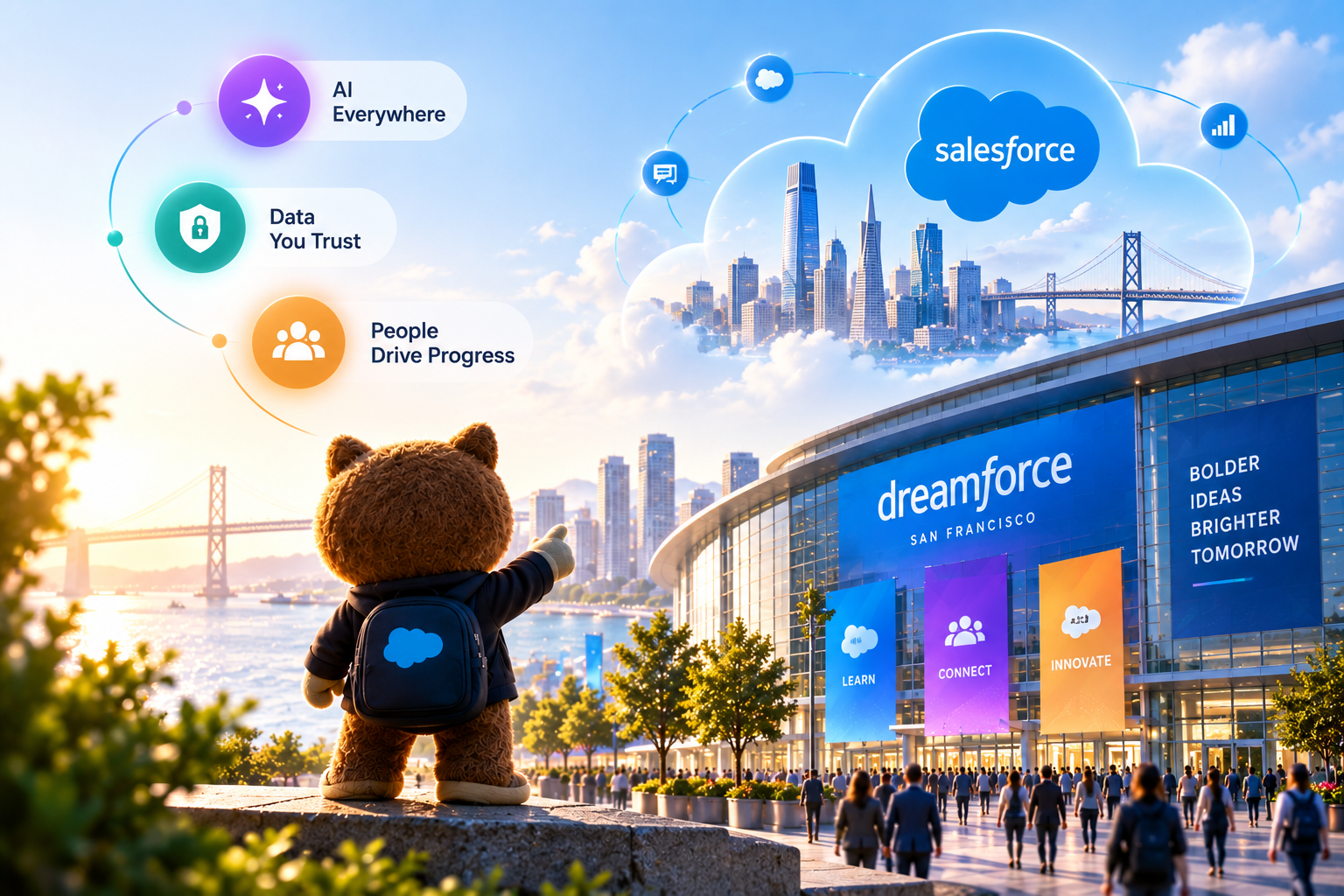
Dreamforce 2026 officially kicked off in San Francisco, gathering thousands of ecosystem trailblazers for 3 days of product launches, networking, and strategy. Salesforce CEO Marc Benioff took center stage during the main keynote to unveil a major architectural shift: moving from traditional user interfaces to ambient, agent-driven workflows.
If you missed the live stream from Moscone Center, here are the 6 biggest takeaways every ecosystem professional needs to know.
1. AIforce Arrives: The Death of the Traditional CRM UI

The single largest announcement from the keynote was AIforce Salesforce’s new paradigm designed to eliminate context-switching by embedding CRM intelligence wherever teams naturally collaborate.
Instead of forcing users to use the standard Salesforce Lightning tabs, AIforce delivers data, logic, and reasoning directly to tools such as Slack, Claude, and custom endpoints. People are able to update records, carry out complex workflows, and query enterprise knowledge all without having to open the standard CRM application.
The AIforce suite centers around 4 key pillars:
- Claudeforce: Deep integration powered by Anthropic’s intelligence models.
- Slackforce: Rich contextual CRM data visualizers embedded directly into Slack channels.
- Agentforce Coworker: Autonomous AI teammates designed natively for the Lightning interface.
- The Headless Toolkit: Developer utilities, Model Context Protocol (MCP) servers, APIs, and plug-in skills.
2. Claudeforce Hits Open Beta on AppExchange

Patrick Stokes, President of Applications and Marketing, addressed Parker Harris’s viral statement that users might “never log into Salesforce again.” Stokes emphasized that Salesforce's core asset isn’t its visual layout, but the underlying trust, security architecture, and business logic.
To demonstrate this shift, Stokes revealed a customized command center built entirely through conversational prompts with Claude, complete with an interactive, AI-driven digital assistant version of Parker Harris providing real-time pipeline updates.
- Immediate Access: The Salesforce for Claude plugin is live today in Open Beta on the Salesforce AppExchange.
- Hands-on Labs: Attendees at Moscone West gained access to AI Learning Labs featuring over 100+ laptops pre-configured with Claudeforce environments.
- Pre-built Intelligence: The solution launches equipped with 37 pre-configured sales skills built on top of secure MCP connections.
3. Strict Zero Data Retention: Privacy Takes Center Stage
Addressing growing enterprise privacy concerns around generative models, Benioff reaffirmed Salesforce’s foundational commitment to data security.
Salesforce ensures that there is 0% data retention with respect to its AI tools and its external partnerships with large language models. Although enterprise data is used dynamically in order to process and reason about queries, the third-party model providers never store it or employ it in the training of their external foundational models. This boundary has been repeatedly audited and stress-tested by Salesforce's internal security teams to make certain that full compliance is maintained.
4. Debunking the “SaaSpocalypse” Narrative
Salesforce addressed head-on the industry chatter suggesting AI agents will make traditional software applications obsolete. The keynote opened with a pre-recorded message from Matthew McConaughey stating that the market isn’t facing the end of software, but rather “the end of software that forces humans to do all the work.”
Benioff dismissed doom-and-gloom industry claims of a SaaS collapse as “crazy nonsense,” pointing to strong quarterly growth figures. NVIDIA CEO Jensen Huang joined Benioff on stage to reinforce this point, explaining that agentic AI operates as an intelligent execution layer on top of underlying enterprise systems rather than replacing core software records.
5. Industry Giants Clashing on AI Regulation & Safety
The keynote featured high-profile fireside chats with leaders shaping the modern tech landscape, revealing starkly different philosophies on AI governance:
Jensen Huang (NVIDIA):
- Framework: Viewed the movement as a new Industrial Revolution.
- Regulatory Stance: Argued that market forces are sufficient and new regulatory legislation isn’t necessary.
- Safety Approach: Framed safety strictly as an engineering responsibility, if a system isn’t safe, don’t ship it, but move as fast as possible otherwise.
Dario Amodei (Anthropic):
- Framework: Highlighted the rapid diffusion of technology across enterprise sectors.
- Regulatory Stance: Advocated for responsible industry benchmarking and thoughtful international standards.
- Utilization: Noted that even if AI capability advancement paused today, most enterprise organizations have only unlocked 5% to 10% of the potential value current models offer.
6. The Growing Salesforce-to-Anthropic Talent Pipeline
A subtle yet intriguing moment during the keynote occurred when Benioff acknowledged several former Salesforce employees working alongside Dario Amodei at Anthropic.
Data shows that over 45 former Salesforce professionals joined Anthropic during 2026, making Salesforce the top talent source for Anthropic’s Go-To-Market (GTM) strategy. Rather than viewing this talent migration negatively, Benioff framed the ecosystem mobility as a key indicator of executive development and platform strength across the broader AI landscape.
Key Strategic Takeaways for Businesses
Compared to Dreamforce '24 (which focused primarily on standalone Agentforce rollouts) and Dreamforce '25 (which unveiled Agentforce 360), Dreamforce '26 represents an architectural shift toward headless CRM workflows.

- AIforce Architecture: Eliminates UI context-switching for end users and operations teams.
- Salesforce for Claude Plugin: Provides instant conversational UI generation for sales and marketing leadership.
- MCP Headless Toolkit: Delivers secure endpoint integration via open protocols for developers and technical architects.
- Zero Data Retention Shield: Maintains strict enterprise compliance for CISOs and security teams.