Cursor vs. Claude vs. Lovable: The Ultimate Vibe Coding Showdown
Published on: 25 February 2026
Author: Tanmay Dandile
Introduction
Vibe coding is quickly changing how developers build software. Instead of writing every line manually, you guide AI tools using intent, context, and natural language. The result is faster prototyping, cleaner code, and better developer flow.
But with tools like Cursor, Claude, and Lovable gaining traction, choosing the right one is not obvious. Each promises smarter assistance and faster development. In this post, we share what happened when we tested them head-to-head. You will learn where each tool shines, where it struggles, and which one fits real-world development needs.
The Main Concept: What Is Vibe Coding and Why It Matters ?
Vibe coding is not just AI autocomplete. It is a workflow shift.
Traditional coding focuses on syntax first. Vibe coding focuses on intent first. You describe what you want. The AI helps you build it faster.
Why this matters for developers?
- Faster prototyping
- Reduced boilerplate work
- Better focus on architecture
- Improved experimentation speed
For teams building modern apps - especially MERN, React Native, or AI-powered platforms - vibe coding can significantly reduce development time.
However, the tool you choose affects:
- Code quality
- Context understanding
- Debugging support
- Team productivity
That is why we ran a comparative test.
The Solution - Cursor vs. Claude vs. Lovable Deep Dive
Our Testing Criteria
We evaluated all three tools on:
- Code generation quality
- Context awareness
- Debugging ability
- Developer experience
- Real-world usability
Cursor: The Developer-First Power Tool:
Cursor feels closest to a traditional IDE experience. It is built for developers who want AI deeply embedded into their coding workflow.
Strengths
- Excellent codebase awareness
- Strong refactoring support
- Works well with large projects
- Familiar IDE experience
Limitations
- Learning curve for new users
- Less conversational than Claude
- Requires good prompts for best results
Best for: Professional developers working on large production codebases.

Claude: The Context Intelligence Leader
Claude stands out for its reasoning and long-context understanding. It behaves more like a senior engineer reviewing your work.
Strengths
- Exceptional code explanations
- Strong debugging help
- Handles long context very well
- Great for architecture discussions
Limitations
- Not an IDE replacement
- Slower for rapid iteration
- Less integrated into dev workflow
Best for: Deep thinking, debugging, and system design support.

Lovable: The Rapid Builder
Lovable focuses on speed and simplicity. It is designed for fast prototyping and product experimentation.
Strengths
- Very fast UI generation
- Beginner friendly
- Great for MVPs
- Simple workflow
Limitations
- Limited depth for complex systems
- Less control for senior developers
- Not ideal for large codebases
Best for: Founders, quick prototypes, and early-stage products.

Visual Example
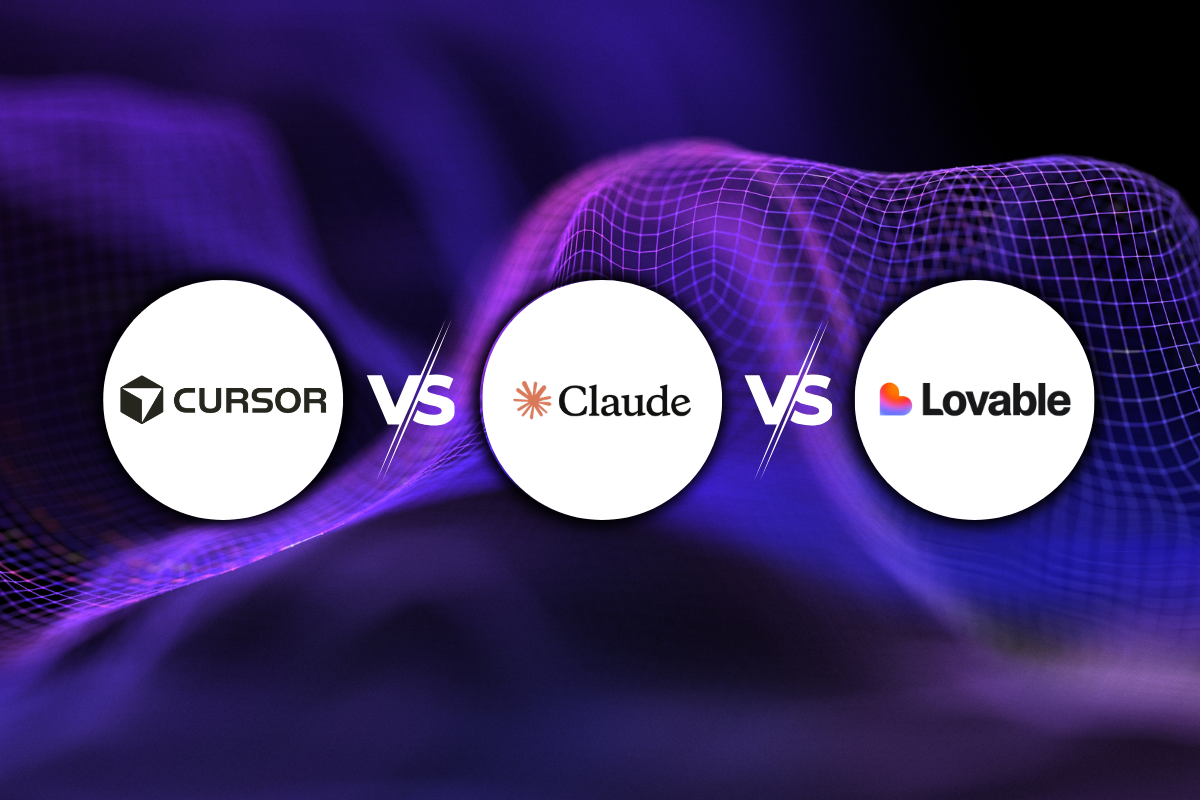
Featured Image: Cursor vs Claude vs Lovable interface comparison

Real-World Use Cases
Use Case 1: MERN Stack Development
- Cursor: Best for maintaining large MERN repositories
- Claude: Best for debugging complex Node.js logic
- Lovable: Best for quick React UI scaffolding
For developers like you working heavily in MERN, Cursor + Claude together often gives the strongest workflow.
Use Case 2: Rapid MVP Development
If your goal is speed:
- Lovable gets you to demo fastest
- Claude helps refine logic
- Cursor helps productionize
This layered approach is becoming common in modern teams.
Use Case 3: Enterprise Codebases
- Cursor leads in code navigation
- Claude leads in reasoning
- Lovable is usually insufficient
According to industry analysts, AI-assisted development is expected to significantly reshape software productivity over the next few years. (External reference below.)
Conclusion
Vibe coding is not a trend. It is a shift in how modern software gets built.
Cursor excels at deep IDE integration. Claude leads in reasoning and debugging. Lovable wins in rapid prototyping. The best choice depends on your workflow maturity and project complexity.
For most professional teams, the winning strategy is not choosing one tool. It is combining them intelligently. As AI-assisted development evolves, developers who master this stack will move significantly faster than the rest.
Which tool fits your workflow today?
Internal Resources
- Internal Link 1: https://www.bugendaitech.com/blog-details/claude-3-5-sonnet-a-new-leader-in-ai
- Internal Link 2: https://www.bugendaitech.com/blog-details/what-makes-an-ai-agent-tool-using-llm-systems
Resources / References
- Anthropic Claude Documentation
- Cursor Official Documentation
- Forbes - The Rise of AI-Assisted Software Development (external reference)
- External Link: Forbes - AI-Assisted Development Trends
About the Author
Tanmay is a MERN and React Native developer focused on building scalable, AI-enhanced applications. He specializes in developer productivity, modern frontend systems, and cloud-integrated architectures.
Want to accelerate your AI development journey?