How Governments Are Using AI to Improve Citizen Services, Compliance, and Efficiency
Published on: 30 June 2026
Author: Jyoti
Introduction
Governments worldwide are under increasing pressure to deliver faster services, improve transparency, reduce operational costs, and meet growing citizen expectations. Traditional government processes often involve large volumes of paperwork, lengthy approval cycles, and manual administrative tasks that can slow down service delivery.
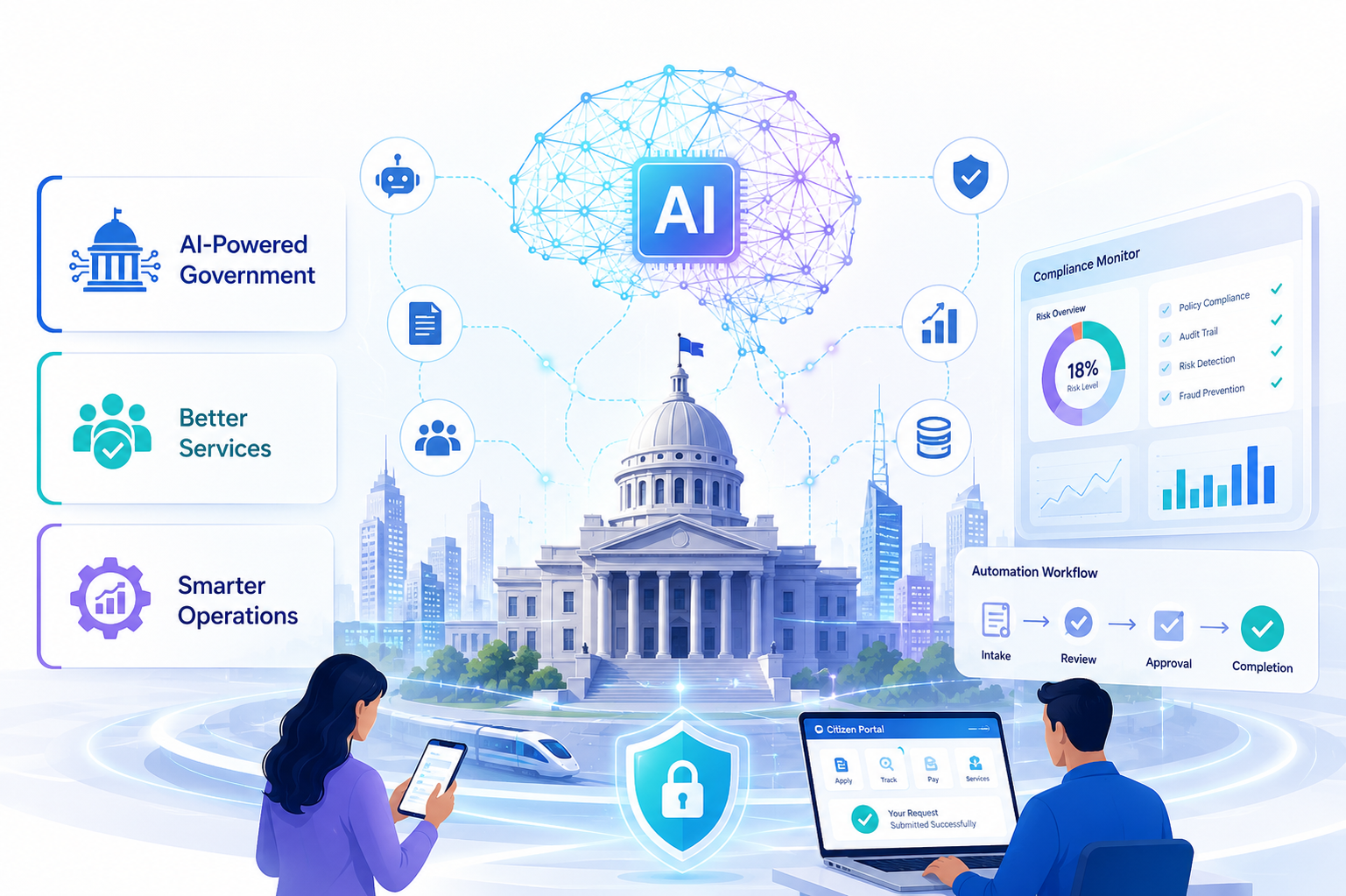
Artificial Intelligence (AI) is helping public sector organizations address these challenges. From automating citizen support to improving compliance monitoring and streamlining operations, AI is transforming how governments serve their communities.
According to industry reports, governments are increasingly investing in AI-powered solutions to enhance public service delivery, strengthen regulatory compliance, and improve decision-making. As AI technologies continue to evolve, public sector agencies are finding innovative ways to create more efficient, citizen-centric services.
In this article, we'll explore how governments are using AI to improve citizen services, compliance, and operational efficiency, along with the benefits, challenges, and future opportunities.
Why AI Is Becoming Essential for Government Agencies
Government agencies manage massive amounts of data and handle millions of citizen interactions every day. Citizens expect the same level of convenience and responsiveness they receive from private-sector organizations.
AI helps governments by:

Rather than replacing public servants, AI enables employees to focus on higher-value tasks that require human judgment and expertise.
AI-Powered Citizen Services: Improving Public Experience
One of the most impactful uses of AI in government is enhancing citizen services.
1. AI Chatbots and Virtual Assistants
Government agencies receive thousands of inquiries daily regarding permits, taxes, benefits, licenses, healthcare programs, and public services.

Instead of waiting on hold for assistance, citizens can receive immediate answers through government websites and digital service portals.
Benefits
2. Personalized Citizen Experiences
AI enables governments to deliver more personalized services based on citizen needs and preferences.
For example, AI can:
- Recommend relevant government programs
- Send reminders for license renewals
- Notify citizens about benefit eligibility
- Provide customized service recommendations
This proactive approach improves engagement while ensuring citizens receive the services they qualify for.
3. Multilingual Service Delivery
Many governments serve diverse populations with multiple language requirements.
AI-powered translation tools help agencies:
- Translate documents automatically
- Support multilingual chatbots
- Improve communication with non-native speakers
- Enhance accessibility for diverse communities
This helps governments provide more inclusive public services.
How AI Strengthens Government Compliance
Regulatory compliance is a critical responsibility for public sector organizations. Governments must ensure that policies, regulations, and procedures are consistently followed across departments.
AI is helping agencies improve compliance management through automation and continuous monitoring.
1. Automated Compliance Monitoring
Manual compliance reviews are time-consuming and resource-intensive.

This allows agencies to identify issues before they become major problems.
2. Fraud Detection and Prevention
Government fraud costs billions of dollars globally every year.
AI can analyze large datasets and identify suspicious patterns that humans might miss.
Examples include:
- Tax fraud detection
- Benefits fraud identification
- Procurement fraud monitoring
- Financial irregularity detection
Machine learning algorithms continuously improve their ability to identify potential fraud risks.
3. Audit and Reporting Automation
Preparing compliance reports often requires extensive manual effort.

This improves accuracy while reducing administrative burden.
AI Driving Operational Efficiency Across Government Agencies
Efficiency is a major priority for public sector organizations facing budget constraints and growing service demands.
AI helps agencies accomplish more with existing resources.
1. Automating Administrative Processes
Many government processes still rely heavily on manual data entry and document handling.
AI-powered automation can streamline:
- Permit processing
- License approvals
- Form validation
- Records management
- Workflow routing
This reduces delays and improves overall productivity.
2. Intelligent Document Processing
Government agencies process millions of documents annually.
AI can automatically:
- Extract information from forms
- Classify documents
- Verify records
- Process applications
- Digitize paper-based information
This significantly reduces manual workload and processing times.
3. Data-Driven Decision Making
Governments collect enormous volumes of data from multiple departments and programs.
AI helps agencies:
- Analyze trends
- Forecast demand
- Identify service gaps
- Optimize resource allocation
- Improve policy development
Leaders can make better decisions using real-time insights rather than relying solely on historical reporting.
Real-World Government AI Use Cases

Challenges Governments Must Address
While AI offers significant benefits, governments must also address several challenges.
Data Privacy and Security
Government agencies manage sensitive citizen information that must be protected from cyber threats and unauthorized access.
Ethical AI and Bias
AI systems must be fair, transparent, and accountable. Governments need strong governance frameworks to prevent biased outcomes.
Workforce Readiness
Employees need training and support to effectively work alongside AI-powered systems.
Regulatory Compliance
Governments must ensure AI solutions comply with evolving regulations, privacy laws, and security requirements.
Best Practices for Successful Government AI Adoption
To maximize AI success, agencies should:
Establish Strong AI Governance
Develop policies that define responsible AI usage, accountability, and oversight.
Prioritize Security and Privacy
Implement robust cybersecurity controls and data protection measures.
Maintain Human Oversight
AI should support decision-making while humans remain responsible for critical outcomes.
Start with High-Impact Use Cases
Focus on areas where AI can quickly deliver measurable improvements in service delivery and efficiency.
Invest in Employee Training
Equip government workers with the skills needed to effectively use AI technologies.
Challenges Governments Must Address
While AI offers significant benefits, governments must also address several challenges.
Data Privacy and Security
Government agencies manage sensitive citizen information that must be protected from cyber threats and unauthorized access.
Ethical AI and Bias
AI systems must be fair, transparent, and accountable. Governments need strong governance frameworks to prevent biased outcomes.
Workforce Readiness
Employees need training and support to effectively work alongside AI-powered systems.
Regulatory Compliance
Governments must ensure AI solutions comply with evolving regulations, privacy laws, and security requirements.
Best Practices for Successful Government AI Adoption
To maximize AI success, agencies should:
Establish Strong AI Governance
Develop policies that define responsible AI usage, accountability, and oversight.
Prioritize Security and Privacy
Implement robust cybersecurity controls and data protection measures.
Maintain Human Oversight
AI should support decision-making while humans remain responsible for critical outcomes.
Start with High-Impact Use Cases
Focus on areas where AI can quickly deliver measurable improvements in service delivery and efficiency.
Invest in Employee Training
Equip government workers with the skills needed to effectively use AI technologies.
The Future of AI in Government
The future of government services will increasingly be powered by AI.
Emerging technologies such as Generative AI, Agentic AI, predictive analytics, and intelligent automation will help agencies deliver faster, smarter, and more personalized services.
Governments that embrace responsible AI adoption today will be better positioned to improve citizen experiences, strengthen compliance, and operate more efficiently in the years ahead.
The goal is not simply to automate government processes but to create more responsive, transparent, and citizen-focused public services.
Conclusion
Artificial Intelligence is transforming the public sector by helping governments improve citizen services, strengthen compliance efforts, and increase operational efficiency.
From AI-powered chatbots and fraud detection systems to intelligent document processing and predictive analytics, governments are leveraging AI to modernize operations and better serve their communities.
As adoption continues to grow, success will depend on balancing innovation with responsible governance, security, transparency, and human oversight.
When implemented thoughtfully, AI can help governments build more efficient, accessible, and citizen-centric services for the future.