SOC 2 Type 1 vs Type 2: 7 Easy Ways to Pick the Best Report
Published on: 05 August 2026
Author: Annapurna
If you are expanding your B2B SaaS platform or selling to mid-market and enterprise buyers, you have almost certainly hit a familiar brick wall in vendor procurement:
"Please provide your latest SOC 2 report."
For tech startups and growing digital enterprises, navigating SOC 2 compliance can feel like learning a completely new language. Developed by the American Institute of Certified Public Accountants (AICPA), SOC 2 (System and Organization Controls 2) has become the gold standard for evaluating how cloud-hosted companies protect customer data.
However, as soon as you dive into audit preparation, you are faced with a strategic fork in the road: Should you go for a SOC 2 Type 1 or a SOC 2 Type 2 report?
Choosing the wrong path can delay sales cycles, drain internal resources, or cause you to overspend on audit fees. In this guide, we will break down the fundamental differences between SOC 2 Type 1 vs Type 2, answer the critical question of which SOC 2 report do enterprise clients require, and walk through 7 straightforward ways to choose the right audit for your business goals.
What Is SOC 2?
Before comparing the two report types, it helps to understand what a SOC 2 audit actually measures. Unlike standard ISO frameworks, SOC 2 is not a pass/fail certification, it is an independent attestation report issued by a licensed CPA firm / independent auditor.
What Is the Difference Between SOC 2 Type 1 and Type 2?

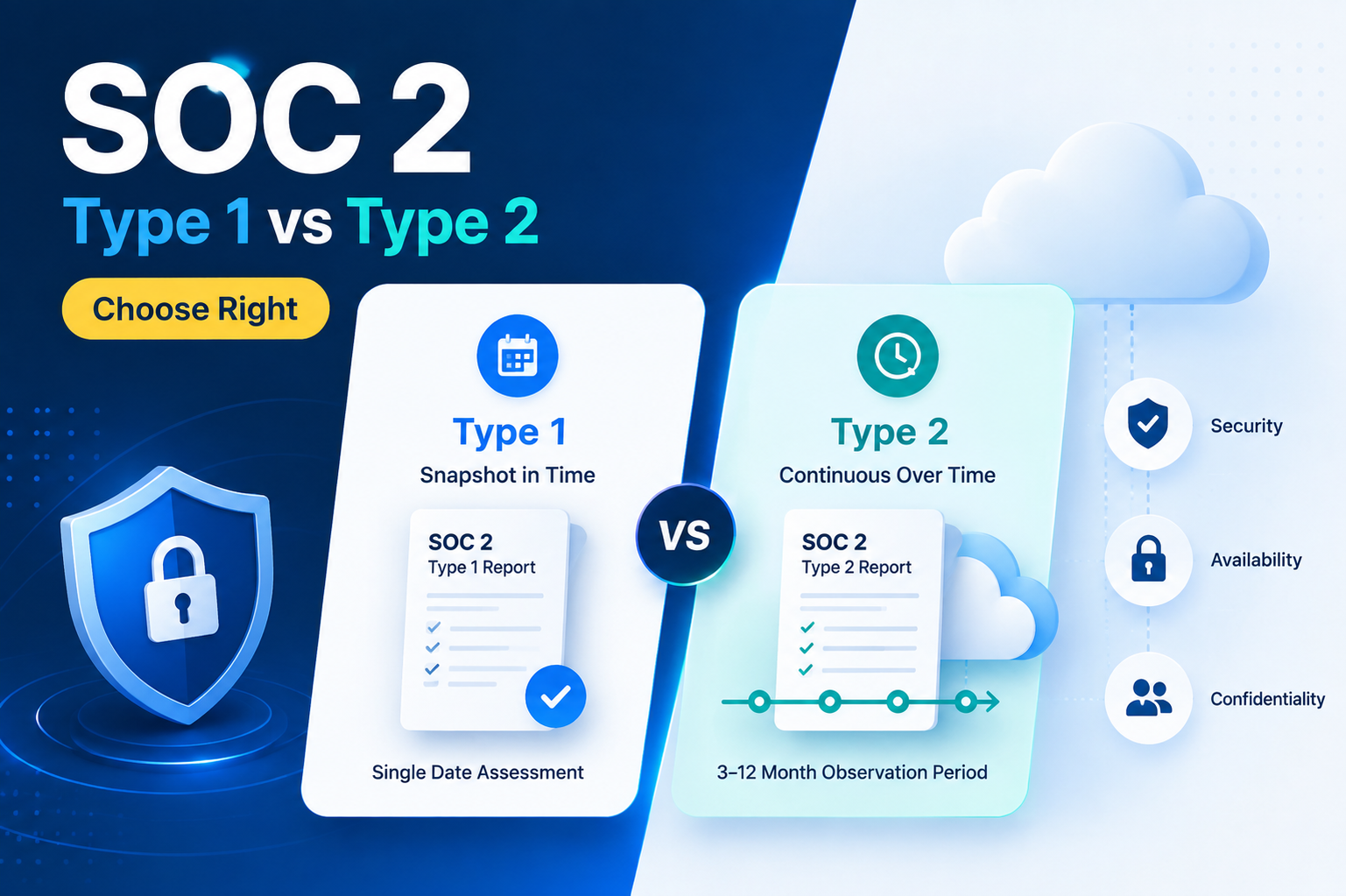
The core difference between SOC 2 Type 1 and Type 2 lies in time.
SOC 2 Type 1 evaluates the design of your security controls at a single point in time. It acts as a snapshot, proving that as of a specific date (e.g., August 1, 2026), you have proper security policies, infrastructure controls, and procedures documented and configured correctly.
SOC 2 Type 2 evaluates the operational effectiveness of those security controls over an observation period (typically 3 to 12 months, with 6 months being the standard minimum for a first audit). It proves that your security controls did not just exist on paper, they were actively followed and maintained continuously over time.
Think of Type 1 like passing a written driving test (you know all the rules and have the manual setup), whereas Type 2 is the actual road test (you prove you can drive safely continuously without running red lights).
7 Easy Ways to Pick the Best Report for Your Business
To determine the right compliance strategy for your pipeline and budget, evaluate your current position across these seven key factors:

1. Speed to Sales & Deal Velocity
If a key enterprise deal is stalled in legal procurement because you lack proof of security, a SOC 2 Type 1 is your fastest escape route. Because a Type 1 audit evaluates a single date, a licensed CPA firm can complete the assessment in 2 to 4 weeks once your controls are in place. A Type 2 audit, by contrast, requires waiting out the mandatory observation period (3 to 12 months) before the auditor can issue the final report.
2. Enterprise Buyer Expectations
When evaluating which SOC 2 report do enterprise clients require, the answer is almost always Type 2. Fortune 500 security teams and enterprise procurement officers want proof that your team actively practices continuous security, such as conducting monthly access reviews, maintaining regular data backups, and applying patch management reliably. While a Type 1 report may temporarily satisfy a prospect to move a deal forward, most enterprise contracts include a clause requiring a Type 2 report within 6 to 12 months.
3. Current Maturity & Compliance Readiness
Are you starting from scratch, or do you already have robust security practices? Starting directly with a Type 2 audit without a prior readiness assessment and gap analysis carries a high risk of audit exceptions (findings where a control failed during the testing period). Performing a Type 1 audit first allows you to stress-test your control environment, refine automated evidence collection, and fix operational gaps before entering a live Type 2 observation window.
4. Audit Timeline & Duration
Understanding how long does a SOC 2 Type 2 audit take helps prevent project delays:
- SOC 2 Type 1 Timeline: 1 to 2 months total (2–4 weeks prep/readiness + 2–4 weeks audit review).
- SOC 2 Type 2 Timeline: 6 to 13 months total (1–2 months readiness + 3–12 months observation period + 4–6 weeks auditor evaluation and reporting).
5. Cost & Budget Allocation
While costs vary based on organization size, system complexity, and scope, here are typical industry benchmarks:
- SOC 2 Type 1 Cost: Auditor fees generally range from $10,000 to $25,000.
- SOC 2 Type 2 Cost: Auditor fees generally range from $30,000 to $60,000+ for an initial audit.
Note that these figures cover external CPA audit fees. You should also account for modern compliance automation platforms (such as Vanta, Drata, or Secureframe) which cost between $10,000 and $30,000 annually, as well as internal technical remediation expenses.
6. Vendor Due Diligence & Security Questionnaires
If your sales team spends dozens of hours every month answering manual 200-question security questionnaires, a SOC 2 report drastically accelerates vendor due diligence. Providing a Type 1 report shows buyers you take security seriously, but providing a Type 2 report allows you to skip the majority of third-party risk questionnaires entirely.
7. Long-Term Compliance Roadmap
For early-stage startups asking about SOC 2 compliance for startups, a phased approach is often the smartest strategy.
- Phase 1: Conduct a readiness assessment and obtain a SOC 2 Type 1 report to unlock early sales pipeline.
- Phase 2: Immediately transition the date of your Type 1 report into Day 1 of your Type 2 observation period.
This phased roadmap gives you immediate marketplace credibility while building the operational foundation needed for full Type 2 attestation.
SOC 2 Type 1 vs Type 2: Side-by-Side Comparison
| Feature | SOC 2 Type 1 | SOC 2 Type 2 |
|---|---|---|
| What It Tests | Design of controls at a single point in time | Design & operational effectiveness of controls over time |
| Testing Period | Specific single date (e.g., Aug 1) | 3 to 12 months (6 months standard for initial audit) |
| Time to Complete | 2 to 4 weeks (after readiness) | 6 to 12+ months |
| Average Audit Cost | $10,000 – $25,000 | $30,000 – $60,000+ |
| Who Accepts It? | Early-stage buyers, SMBs, mid-market prospects | Enterprise buyers, Fortune 500 procurement, regulated sectors |
| Best For | Startups needing quick proof of security to unblock deals | Established companies scaling enterprise sales & closing risk gaps |
Beyond SOC 2: Brief Distinctions (SOC 1 vs SOC 2 vs SOC 3)
When building your compliance strategy, you may encounter other AICPA report frameworks:
- SOC 1: Focuses strictly on financial reporting controls (relevant if your software impacts a client's financial statements, like payroll or accounting SaaS).
- SOC 2: Focuses on operational security, availability, and data trust criteria (the standard for B2B SaaS and cloud service providers).
- SOC 3: A freely distributable, high-level summary of the SOC 2 Type 2 audit designed for public display on your website without signing a Non-Disclosure Agreement (NDA).
Streamline Your SOC 2 Journey with Expert Guidance
Navigating security frameworks, configuring cloud infrastructure controls, and preparing for CPA audit sampling doesn't have to stall your engineering roadmap. Whether you need a comprehensive readiness assessment, automated policy mapping, or end-to-end audit support, working with an experienced partner ensures you get compliant faster and without operational friction.
Ready to clear vendor security checks and accelerate your sales pipeline?