7 Powerful Ways SOC 2 Type II Protects Every Customer
Published on: 21 August 2026
Author: Abhishek Singh
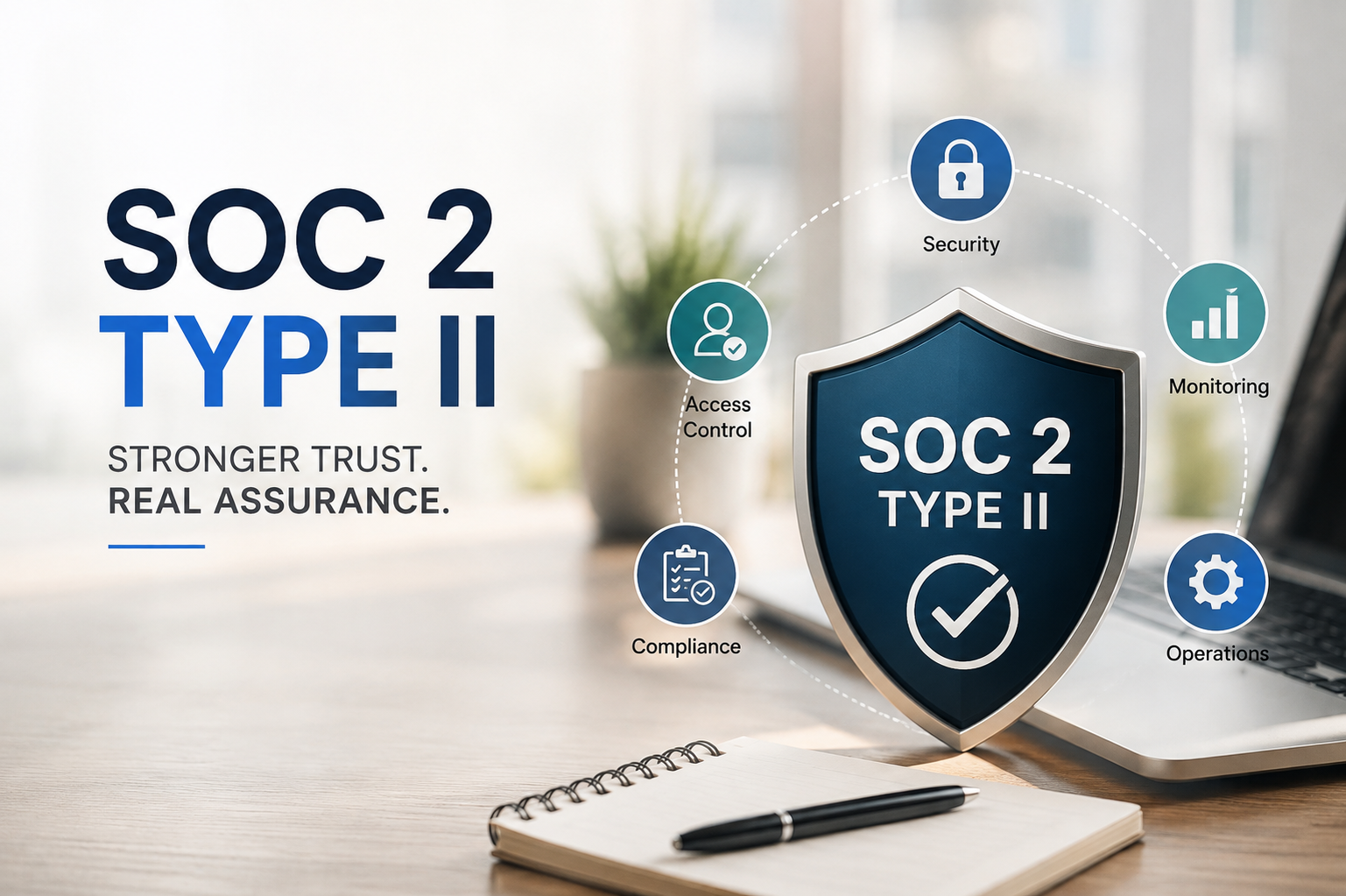
When you're working with a technology partner, you shouldn't rely on security alone.
Your implementation partner could have access to Salesforce environments, business data, integrations, internal systems, and in some cases sensitive customer information. That is why the essential question is not merely "Do they have security policies?"
The question is: do those controls actually function in practice?
This is where SOC 2 Type II acquires importance.
For BugendaiTech customers, the SOC 2 Type II attestation serves as independent evidence that the relevant controls were both properly designed and effectively operated during the examination period; the report relates to the controls within the scope of the engagement and does not make the general claim that all aspects of a company's security have been certified.

BugendaiTech has its head office in Scottsdale, Arizona, and it has delivery teams which support customers at a number of locations. The examination referred to in the company's SOC 2 Type II report covers a six-month period from October 1, 2025, to March 31, 2026.
For anyone who is considering a Salesforce consulting, integration or technology partner, the phase of independent testing provides useful evidence of how the established controls functioned during the examination.
What Does SOC 2 Type II Actually Verify?
SOC 2 Type II is designed to provide information about a service organization's controls and whether those controls operated effectively over a defined period.
That distinction matters.
A company can have a well-written security policy and still have gaps in how that policy is followed. Type II examinations are useful because the auditor examines evidence from the operating period rather than looking only at the design of the controls.
The American Institute of CPAs (AICPA) defines SOC 2 reporting around controls relevant to the Trust Services Criteria, including Security, Availability, Processing Integrity, Confidentiality, and Privacy.
In simple terms:
Type I asks, “Are the controls suitably designed?”
Type II goes a step further and asks, “Did those controls operate effectively during the examination period?”
For a technology customer, that difference can matter when evaluating third-party risk.
When enterprises engage BugendaiTech for Salesforce implementations, MuleSoft integrations, data work, or AI application development, they may give project teams access to business systems and information. A SOC 2 Type II examination provides independent assurance over the controls that fall within the defined scope of the report.
How is SOC 2 Type II different from Type I?
The easiest way to understand the difference is to think about a snapshot versus a period of observation.
A SOC 2 Type I report focuses on the suitability of the design of controls at a particular point in time.
A SOC 2 Type II report also considers whether those controls operated effectively during the examination period.
| Aspect | SOC 2 Type I | SOC 2 Type II |
|---|---|---|
| What's tested | Control design | Control design and operating effectiveness |
| Time window | Point in time | Defined examination period |
| Evidence | Evidence supporting control design | Evidence showing controls operated during the period |
| Buyer perspective | Security snapshot | More evidence of sustained operation |
| BugendaiTech's report | Not pursued | SOC 2 Type II |
What did the SOC 2 Type II audit examine?
A SOC 2 examination involves more than reviewing a company's security policies.
The service auditor evaluates evidence relating to the controls included in the examination. Depending on the scope, this can involve areas such as:

The important part is that the auditor relies on evidence and testing rather than simply accepting a verbal assurance that a process exists.
The AICPA's SOC 2 guidance specifically describes Type 2 reporting in terms of the suitability of control design and operating effectiveness.
Why is SOC 2 Type II vital for Salesforce implementation partners?
Salesforce environments often sit at the center of a company's sales, service, customer, and operational data. This makes implementation partners an important part of an organization's third-party risk profile.
Partners may work across Sales Cloud, Service Cloud, Data Cloud, integrations, APIs, custom applications, sandboxes, and production environments, and may access sensitive business data and processes.
That's why security matters when choosing a Salesforce implementation partner.
At BugendaiTech, security is built into project practices through controls such as access management, restricted credential handling, and appropriate test data in development environments.
Where these practices fall within the SOC 2 examination scope, a Type II report provides independent evidence of how relevant controls are designed and operated over time.
SOC 2 doesn't eliminate risk, but it gives customers valuable, independent assurance when evaluating a technology partner.
How does SOC 2 Type II compare to Type I and ISO 27001?
SOC 2 and ISO 27001 are often mentioned together during enterprise security reviews, but they are not the same thing.
SOC 2 focuses on controls relevant to the Trust Services Criteria and reports on the service organization's system and controls within the defined scope.
ISO 27001 is a certification standard for an information security management system (ISMS).
They can therefore complement each other rather than being direct substitutes.
| Aspect | SOC 2 Type I | SOC 2 Type II |
|---|---|---|
| Focus | Design of controls at one point in time | Operating effectiveness of controls over a period |
| Typical Duration | Single date | 3–12 months of observation |
| Evidence Reviewed | Policies and control design | Logs, tickets, and samples collected across the period |
| Assurance Level | Lower a snapshot | Higher sustained performance |
| Aspect | SOC 2 Type II | ISO 27001 |
|---|---|---|
| Issued By | Licensed CPA firm | Accredited certification body |
| Output | Detailed attestation report (usually shared under NDA) | Certificate plus Statement of Applicability |
| Scope | Trust Services Criteria relevant to the engagement | Full information security management system (ISMS) |
| Common Use | Preferred by US enterprise and SaaS buyers | Preferred by international and government buyers |
The two are complementary rather than competing many enterprise buyers request a SOC 2 Type II report as evidence of operating effectiveness alongside any other certifications a vendor holds.
How does SOC 2 Type II support compliance across the US, UK/EU, and UAE?
Global organizations often have to deal with several security and privacy requirements at the same time.
A SOC 2 Type II report can help by giving customers independent evidence about specific controls within the report's scope. However, it should not be described as a replacement for laws such as HIPAA, GDPR, UK GDPR, or the UAE's data-protection requirements.
Those are separate legal and regulatory frameworks, with their own requirements.
For example:
United States - HIPAA / HITECH
Organizations handling Protected Health Information may be subject to HIPAA and related requirements.
A SOC 2 report can provide useful evidence about security and privacy controls, depending on its scope. However, SOC 2 itself is not a HIPAA certification. Customers should assess their own HIPAA obligations and determine whether the relevant controls and contractual arrangements meet their requirements.
European Union and United Kingdom - GDPR / UK GDPR
GDPR and UK GDPR require organizations to implement appropriate technical and organizational measures for protecting personal data.
A SOC 2 report can support a vendor-risk review by providing evidence about relevant security and privacy controls. It does not, by itself, establish that an organization is GDPR-compliant.
United Arab Emirates - UAE PDPL
Organizations operating in the UAE may have obligations under the country's data-protection framework, including Federal Decree-Law No. 45 of 2021.
SOC 2 can be one part of a broader security and vendor-assurance process, but customers should still evaluate the specific requirements that apply to their business, data, and processing activities.
The practical takeaway is simple: SOC 2 can support compliance work, but it should not be presented as a substitute for compliance with a particular law.
How can enterprise clients request and inspect our SOC 2 Type II report? Does SOC 2 Type II de-risk enterprise procurement and vendor reviews?
Security teams rarely approve a technology vendor based on a marketing statement alone.
They normally want evidence.
For enterprise customers evaluating BugendaiTech, the SOC 2 Type II report can form part of that evidence. It can be reviewed alongside security questionnaires, contractual requirements, technical architecture, data-processing requirements, and the customer's own risk assessment.
Step-by-Step: How to Request a SOC 2 Report
1. Submit a request
Contact your BugendaiTech account executive or the company's compliance team to request the report.
2. Complete the required NDA
Because SOC 2 reports can contain detailed information about systems and controls, access may be subject to confidentiality requirements.
3. Receive the report securely
Once the required process is completed, the report can be shared through an appropriate secure channel.
4. Discuss questions with the security team
Where required, BugendaiTech can work with the customer's security, procurement, or compliance stakeholders to address questions about the report and the relevant controls.
This can make the vendor-review process more straightforward because security teams have independent audit evidence to review rather than starting entirely from a blank questionnaire.
It does not mean that every customer's security review becomes unnecessary. Each organization still has its own risk profile, contractual requirements, regulatory obligations, and technical environment to consider.
Why Does SOC 2 Type II Matter During Enterprise Vendor Assessment?
Vendor security reviews can become one of the slower parts of enterprise procurement.
Before granting a third-party provider access to systems, APIs, credentials, or sensitive data, security and compliance teams typically need to understand how that provider manages risk.
A SOC 2 Type II report can help answer some of those questions by providing evidence from an independent examination.
Instead of relying only on a vendor's response to a long security questionnaire, a procurement or InfoSec team can also review the relevant SOC 2 report and determine whether the scope and controls address its concerns.
For BugendaiTech customers, this can help make conversations around access management, change management, monitoring, incident response, and other control areas more evidence-based.
The report is not a shortcut around due diligence. It is a useful input into due diligence.
Final Thoughts
Security goes beyond policies or statements; it’s about how consistently controls are managed in practice.
For Salesforce, data, integration, and AI engagements, access, changes, incidents, vendors, and other security controls are critical to customer trust.
SOC 2 Type II provides independent evidence of how defined controls operated during the examination period.
For BugendaiTech customers, this makes the report a valuable part of vendor security and compliance assessments. Reviewing its scope, Trust Services Criteria, examination period, and auditor’s opinion helps customers understand how the attestation aligns with their specific requirements.