Tableau Next: Unlock Smarter Healthcare Decisions with AI
Published on: 23 July 2026
Author: Annapurna
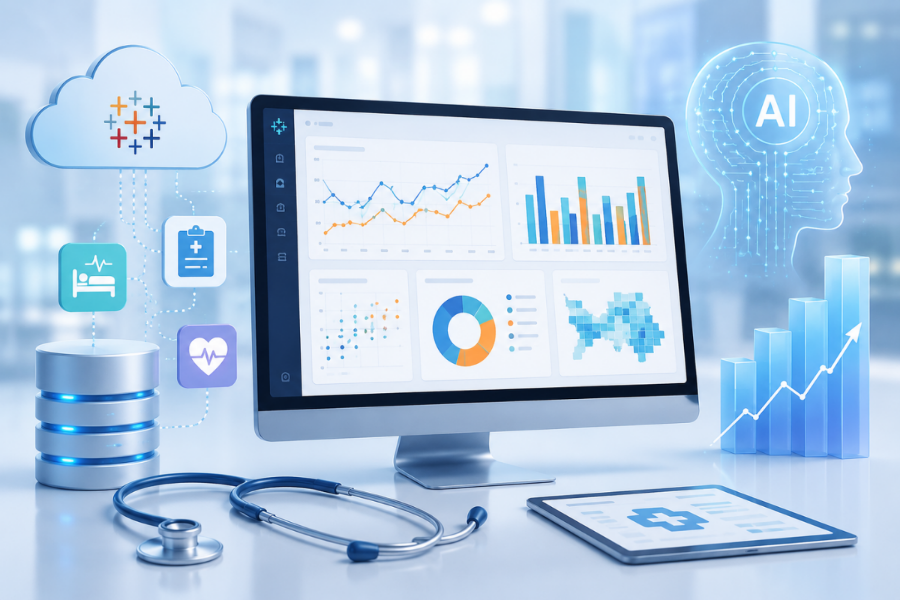
Tableau Next is transforming modern healthcare analytics by introducing composable, agentic AI into clinical and operational workflows. Built on Salesforce Data Cloud and powered by Agentforce, Tableau Next connects directly with Electronic Health Records (EHR) using standards like FHIR. By combining Predictive Analytics and Generative AI, it shifts hospitals from passive reporting to proactive Healthcare Decision Intelligence. Healthcare teams can instantly surface personalized metrics via Tableau Pulse, optimize staffing, reduce readmission rates, and maintain HIPAA compliance, unlocking smarter, automated decisions across the entire care spectrum.
What Is Tableau Next?
Tableau Next: An API-first, agentic analytics platform built natively on the Salesforce platform that turns static data into contextual, automated insights delivered directly within daily workflows.
Tableau Next represents the next generation of business analytics. Unlike traditional Business Intelligence (BI) platforms that require users to hunt through static dashboards, Tableau Next utilizes an AI-infused semantic layer (Tableau Semantics) to bring intelligence to where teams already work.
By marrying the data unifying power of Salesforce Data Cloud with autonomous reasoning from Agentforce, Tableau Next delivers personalized, real-time alerts, natural language summaries, and instant automated actions while adhering strictly to enterprise security standards like HIPAA.

Why Healthcare Needs AI-Powered Decision Intelligence
Healthcare Decision Intelligence: The practice of combining data science, managerial decision frameworks, and artificial intelligence (predictive and generative) to optimize clinical, operational, and financial choices in real time.
Modern health systems are flooded with data, yet clinical leaders frequently face analysis paralysis. Traditional systems trap valuable data inside disparate Electronic Health Record (EHR) silos, lab management tools, and claims databases.
- Market Growth: According to market research from Grand View Research, the global Healthcare Business Intelligence market is projected to expand from $12.8 billion in 2026 to $31.8 billion by 2033.
- Impact of AI: Recent clinical studies published in healthcare journals show that AI-generated clinical recommendations achieve a 77% optimal rating compared to 67% for traditional unassisted physician evaluations.
- Shift to Cloud & Self-Service: Software and cloud-based BI models represent over 70% of market deployment, demonstrating an urgent shift toward real-time accessibility.

How Tableau Next Is Transforming Healthcare Analytics
How Tableau Next is transforming healthcare analytics comes down to three major pillars: interoperability, agentic AI, and real-time execution.
- Unified Data Layer via Data Cloud & FHIR: Tableau Next connects to clinical systems using Fast Healthcare Interoperability Resources (FHIR) protocols. By digesting structured EHR records and unstructured notes into Salesforce Data Cloud, it provides a true 360-degree patient view.
- Shift from Reactive to Proactive: Instead of reviewing last month’s bed occupancy or readmission report, clinicians receive proactive nudges via Tableau Pulse when metrics drift off target.
- Action at the Point of Insight: Through integration with BugendaiTech Salesforce Solutions, care coordinators can trigger automated discharge workflows or alert on-call specialists directly from Slack or CRM interfaces.
Tableau AI Features for Healthcare Business Intelligence
Tableau Next incorporates advanced Tableau AI Features designed specifically to streamline complex data environments:
- Tableau Pulse: An automated insights engine that detects drivers, anomalies, and trends in key performance indicators (KPIs) and delivers natural language summaries to mobile or desktop devices.
- Tableau Agent (Agentforce Integration): Allows non-technical staff to ask natural language questions like "What is our projected ICU bed demand for tonight?" and instantly receive contextual visualizations.
- Tableau Semantics: An AI-infused semantic layer that unifies terminology across departments, ensuring that "length of stay" means the exact same thing in finance as it does in nursing.
- Einstein Trust Layer: Guarantees enterprise-grade HIPAA compliance with strict PII masking, data toxicity screening, and zero data retention by external LLM providers.
Learn how to structure your underlying data assets effectively with BugendaiTech Data & AI Services.
How to Improve Healthcare Decision Intelligence with AI
Health systems asking how to improve healthcare decision intelligence with AI can follow a structured 4-step path:
- Establish Enterprise Data Governance: Enforce unified data standards across legacy EHRs and financial databases.
- Embed Contextual Analytics: Move away from standalone BI portals. Embed insights directly into daily workspaces like Salesforce Health Cloud, EHR consoles, or Slack.
- Combine Predictive & Generative AI: Use Predictive Analytics to forecast patient flow and Generative AI to summarize complex medical records.
- Implement Closed-Loop Automation: Connect insight generation directly to Agentforce workflows to automate administrative updates, follow-up scheduling, and bed allocations.

Tableau Next vs Traditional BI
| Capability / Feature | Traditional BI Tools | Tableau Next |
|---|---|---|
| Architecture | Monolithic, dashboard-centric | Composable, API-first, modular |
| Data Delivery | Pull-based (Users search for dashboards) | Push-based via Tableau Pulse & Slack |
| AI Capabilities | Add-on visual charts & basic formulas | Built-in Agentforce, Generative AI & Predictive Models |
| Semantic Layer | Fragmented per workbook/department | Centralized Tableau Semantics |
| Actionability | Viewing and exporting static PDFs | Executing workflows at the point of insight |
Healthcare Use Cases
1. Patient Care & Readmission Risk Management
By combining clinical risk scores with social determinants of health (SDOH), predictive algorithms flag high-risk patients prior to discharge. Tableau Next automatically alerts care managers and drafts personalized follow-up care plans.
2. Operational Staffing & Emergency Department Flow
Emergency department nurse managers use real-time patient volume forecasts to adjust shift scheduling dynamically. This reduces patient wait times and prevents physician burnout.
3. Revenue Cycle Management (RCM)
Financial teams track claim denial patterns in real time. Tableau AI Features automatically detect billing code discrepancies before submission, lowering denial rates and accelerating cash flow.
Conclusion
The future of healthcare analytics is no longer about building bigger dashboards, it is about empowering care teams with real-time, intelligent guidance. By leveraging Tableau Next, healthcare providers can bridge the gap between complex data and meaningful clinical action.
Ready to modernize your healthcare analytics infrastructure?
References
- Salesforce Official Release & Product Architecture: Tableau Next Analytics Overview
- Grand View Research: Healthcare Business Intelligence Market Report & Trends.
- Towards Healthcare & HIMSS Industry Analysis: Healthcare Intelligence & Data Analytics Growth Outlook.