The Ultimate Task Management Software to Destroy Team Chaos Forever
Published on: 09 May 2026
Author: Annapurna
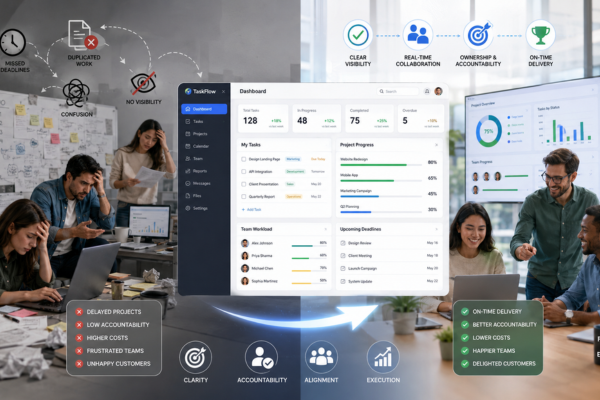
Every growing business eventually hits the same wall.
Projects become difficult to track. Teams lose visibility. Tasks get duplicated. Meetings multiply. Deadlines slip. Employees feel busy all day but struggle to show measurable progress.
What starts as a few disconnected workflows quickly turns into operational chaos.
This is exactly why modern businesses are investing heavily in task management software. But there is a problem most organizations discover too late:
Not all task management tools actually solve team chaos.
Many platforms create more dashboards than accountability. Others become digital to-do lists with little impact on execution. And in large organizations, the lack of ownership, visibility, and prioritization can silently destroy productivity.
The right system does not just organize tasks. It creates clarity, accountability, alignment, and execution across departments.
In this blog, we will explore why most tools fail, what businesses truly need, and how the right platform can transform team performance.
Missed Deadlines and Duplicated Work Drain Team Productivity
When teams operate without structured workflows, confusion spreads quickly.
Marketing launches campaigns without sales alignment. Operations teams miss approvals. Managers chase updates manually. Employees unknowingly work on duplicate tasks because nobody has visibility into who owns what.
Poor communication and workflow inefficiencies remain among the biggest productivity killers in modern organizations.

This becomes even worse for distributed and hybrid teams, where collaboration depends entirely on digital systems.
Without proper task tracking for remote teams, businesses lose execution speed fast.
Unclear Priorities Lead to Wrong Tasks Being Done First
One of the biggest reasons projects fail is not lack of effort. It is lack of clarity.
When priorities constantly shift without centralized visibility, employees spend time working on tasks that may no longer matter. Teams often ask:
- What should I focus on first?
- Who approved this task?
- Is this still a priority?
- Who owns the next step?
Without clear prioritization systems, organizations create bottlenecks that slow down every department.
The best team accountability software solves this by giving:
- Clear ownership
- Deadline visibility
- Priority-based workflows
- Progress tracking
- Real-time status updates
This allows teams to move confidently instead of constantly seeking clarification.
Communication Breakdowns Increase Meeting Load and Slow Decisions
Many organizations unknowingly replace execution with meetings.
Why?
Because updates are scattered across emails, spreadsheets, chats, and disconnected tools. Instead of working, employees spend hours:
- Asking for updates
- Following up on approvals
- Clarifying responsibilities
- Searching for documents
- Attending unnecessary meetings
This communication overload creates decision fatigue and slows productivity.
Modern task management systems centralize discussions, updates, attachments, approvals, and timelines in one place.
When everyone has access to real-time progress visibility, meetings become shorter and decisions happen faster.
Chaos Grows Worse as Teams Scale Without Structured Systems
Small teams can survive on manual coordination for a while. Large organizations cannot. As companies grow:
- Dependencies increase
- Teams become cross-functional
- Processes become complex
- Accountability becomes harder to track
This is where many businesses discover why task management tools fail in large organizations.
The issue is rarely the software itself.
The problem is that most tools are built for simple task lists, not enterprise execution. Large organizations need:
- Role-based permissions
- Workflow automation
- Multi-department visibility
- Real-time reporting
- Process standardization
- Audit tracking
- Scalable collaboration
Without these capabilities, teams create disconnected systems that eventually collapse under operational pressure.
Team Burnout Rises When Effort Does Not Lead to Visible Results
Employees become frustrated when they work hard but cannot see progress. This happens when:
- Tasks disappear into endless backlogs
- Ownership is unclear
- Priorities change constantly
- Contributions are not visible
Over time, this creates burnout and disengagement.
High-performing organizations solve this with transparent execution systems that clearly connect work to outcomes.
Employees stay motivated when they can:
- Track progress
- Understand priorities
- See completed milestones
- Collaborate effectively
- Measure impact
The right task management platform improves not only productivity but also employee confidence and morale.
Why Most Task Management Tools Fall Short
Many businesses adopt tools expecting instant productivity improvements. Instead, they experience:
- Low user adoption
- Incomplete task updates
- Poor reporting
- Notification overload
- Lack of accountability
Why?
Because most tools focus on task creation rather than execution management. They provide boards and lists but fail to solve:
- Ownership confusion
- Cross-team dependencies
- Workflow bottlenecks
- Strategic prioritization
- Enterprise visibility
The result is another disconnected platform employees eventually stop using.
A true execution platform must align people, workflows, and business goals together.
The Ownership Problem Nobody Talks About
One of the most overlooked problems in project execution is unclear ownership.
When multiple people are involved in a process without defined accountability:
- Tasks stall
- Approvals get delayed
- Work gets duplicated
- Deadlines are missed
This is why businesses increasingly search for how to assign clear ownership in project management.
Effective ownership systems include:
- Single-task accountability
- Defined approvers
- Escalation visibility
- Deadline responsibility
- Progress transparency
The best platforms ensure every task has:
- An owner
- A due date
- A status
- A measurable outcome
Without ownership, execution becomes unpredictable.
Visibility Is the Missing Layer
Many organizations have talented teams but poor visibility. Leadership often struggles to answer:
- Which projects are delayed?
- Which teams are overloaded?
- What tasks are blocked?
- Where are bottlenecks forming?
Without centralized visibility, decision-making becomes reactive instead of proactive. Modern task management software provides:
- Real-time dashboards
- Workload balancing
- Progress analytics
- Dependency tracking
- Team performance insights
This visibility enables faster decision-making and stronger operational control.
From Planning to Execution: Closing the Gap
Planning is easy. Execution is where businesses fail.
Organizations often create ambitious project plans that collapse because there is no structured execution layer connecting strategy to action.
The right system bridges this gap by enabling:
- Workflow automation
- Cross-functional collaboration
- Deadline monitoring
- Real-time communication
- Accountability tracking
This transforms project management from static planning into continuous execution management.
Businesses that execute faster gain significant competitive advantages.
What the Ultimate Task Management Software Must Do
The ideal platform should go far beyond basic task lists. It should help organizations:
- Assign clear ownership
- Track dependencies
- Automate repetitive workflows
- Improve team accountability
- Centralize communication
- Monitor execution health
- Scale collaboration across departments

At BugendaiTech, businesses are increasingly exploring intelligent workflow systems that combine automation, accountability, and visibility to simplify execution at scale.
Industries That Benefit Most
Almost every industry benefits from structured task management systems, especially those managing complex operations.

How to Choose the Right Task Management Software
Before selecting a platform, businesses should evaluate:
Scalability
Can the system grow with your organization?
Ease of Adoption
Will teams actually use it consistently?
Automation Capabilities
Can repetitive processes be streamlined?
Integration Support
Does it connect with existing systems?
Reporting Features
Can leadership track performance easily?
Security and Governance
Does it support enterprise-level controls?
Organizations increasingly prioritize workflow visibility, automation, and employee experience when evaluating productivity platforms.
Choosing the right solution is not just about software features. It is about operational transformation.
The Future of Task Management
Task management is evolving rapidly. The future will be driven by:
- AI-powered prioritization
- Predictive workload management
- Intelligent workflow automation
- Real-time collaboration intelligence
- Smart execution analytics
Businesses are moving beyond simple project tracking toward intelligent execution ecosystems.
Organizations that embrace this shift will improve:
- Productivity
- Employee engagement
- Operational speed
- Customer satisfaction
- Decision-making accuracy
The future of work belongs to businesses that can execute with clarity and speed.
Conclusion
Team chaos rarely happens overnight.
It builds gradually through unclear ownership, disconnected communication, poor visibility, and inefficient workflows.
The right task management software does more than organize tasks.
It creates alignment.
It improves accountability.
It enables faster execution.
It reduces burnout.
And most importantly, it helps teams focus on meaningful work instead of operational confusion.
As businesses continue scaling across hybrid and remote environments, structured execution systems will become essential for sustainable growth.
Organizations that invest in visibility, accountability, and workflow intelligence today will be far better prepared for the future of work tomorrow.
Do you want to simplify workflows, improve team accountability, and eliminate execution bottlenecks?
Explore how intelligent workflow solutions from BugendaiTech ‘Any Task Tracker’ can help your organization streamline task management and improve operational clarity.