Agentic Analytics in Healthcare: A Practical Guide
Published on: 14 August 2026
Author: Annapurna
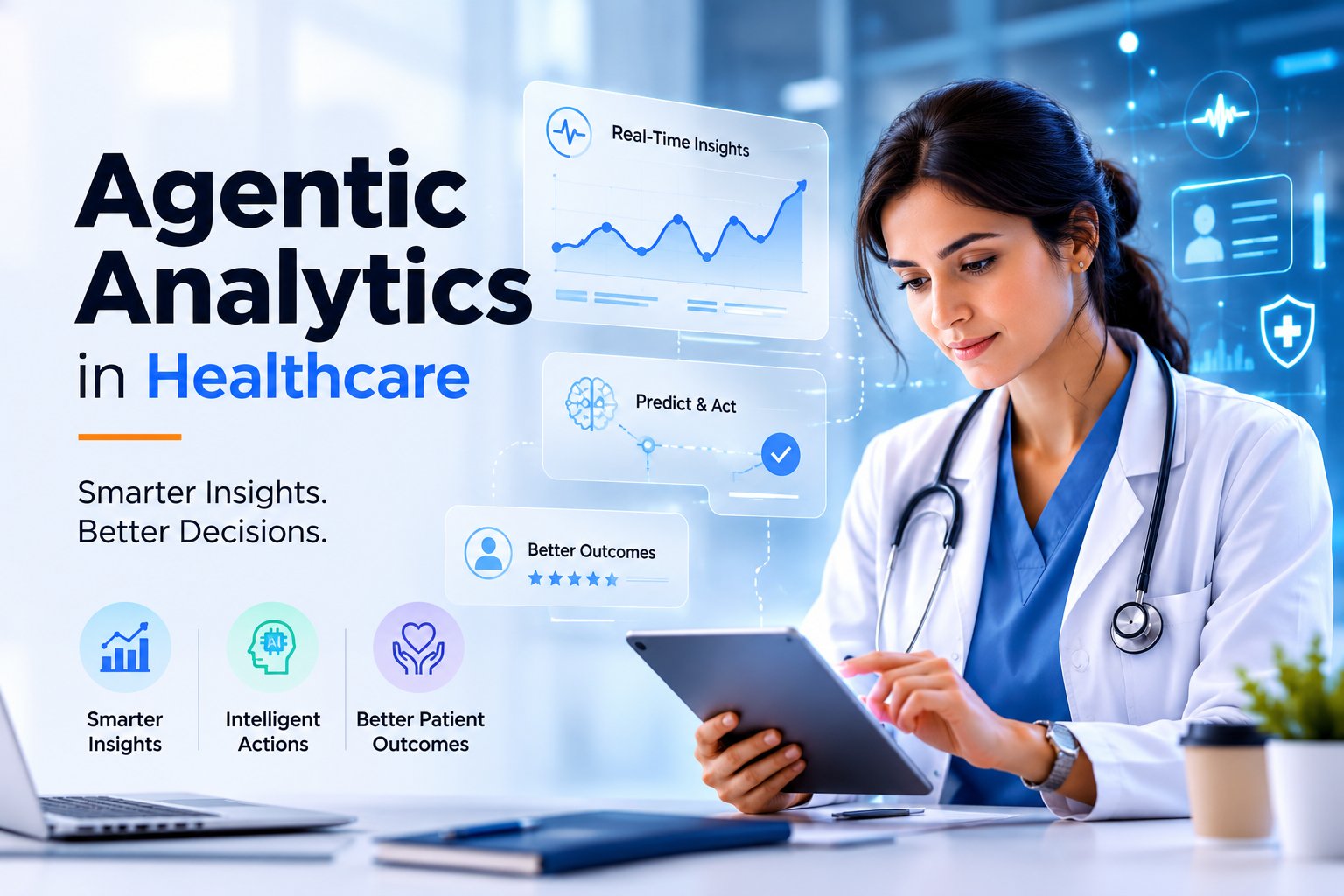
Healthcare has never had a shortage of data.
Hospitals and health systems generate information every minute, from EHR/EMR records and lab results to patient appointments, claims, staffing schedules, clinical notes, and operational metrics. The real challenge is turning all that information into the right decision at the right time.
For years, dashboards and traditional business intelligence (BI) tools have helped healthcare organizations make sense of this data. They are still valuable. But there is a growing gap between seeing what is happening and knowing what to do next.
That is where agentic analytics comes in.
Instead of simply presenting another chart or alert, agentic analytics can continuously monitor data, identify meaningful changes, bring together relevant context, and recommend, or, where appropriately governed, initiate, the next action.
The shift is subtle but important:
For healthcare organizations under constant pressure to improve outcomes while managing costs and operational complexity, that difference could be significant.
What Is Agentic Analytics in Healthcare?
Agentic analytics in healthcare combines analytics, AI agents, automation, and organizational data to create a more active decision-support layer.
A traditional analytics system generally waits for a person to open a dashboard, select filters, examine trends, and interpret the results.
An agentic system can work more continuously.

It can:
- Monitor incoming healthcare data.
- Detect unusual patterns or changes.
- Bring together relevant patient, operational, and historical context.
- Analyze the situation against defined rules, models, or policies.
- Generate an explanation or recommendation.
- Route the recommendation to the appropriate person or workflow.
- Track what happened afterward.
The goal isn't to remove people from healthcare decisions. Quite the opposite.
The goal is to reduce the amount of time healthcare professionals spend searching for information, reconciling systems, monitoring routine patterns, and preparing reports, so they can spend more time on decisions that require human expertise.
This is closely related to clinical decision support (CDS), predictive analytics, workflow automation, and AI agents, but agentic analytics connects these capabilities into a more continuous decision-making process.
Why Dashboards Alone Fall Short
Dashboards changed healthcare analytics for the better. Instead of waiting for a monthly report, leaders could see metrics in one place and identify trends much faster.
But a dashboard still depends heavily on the person looking at it.
Imagine a hospital operations manager looking at today's dashboard.
They notice that emergency department wait times are increasing.
That's useful, but several questions immediately follow:
- Why are wait times increasing?
- Is the problem staffing, patient volume, bed availability, or something else?
- Which department is contributing most to the delay?
- Is this a temporary spike or a developing trend?
- Which resources are currently available?
- What action could reduce the bottleneck?
The dashboard may provide some of those answers. But someone still has to investigate.
This is one of the key differences in agentic analytics vs traditional business intelligence.
Traditional BI is largely human-initiated and insight-oriented.
Agentic analytics aims to become more context-aware, continuous, and action-oriented.
A dashboard might tell a hospital that readmissions increased by 8%.
An agentic analytics workflow could investigate the increase across relevant patient populations, identify contributing patterns, surface high-risk cohorts, and recommend where care-management teams should focus their attention.
That doesn't make the recommendation automatically correct. It makes the information much easier to act on.
How Does Agentic Analytics Work in Hospitals?

So, how does agentic analytics work in hospitals?
At a high level, the process can be thought of as six connected stages.
1. Connect the data
The system integrates information from relevant sources, including EHR/EMR platforms, laboratory systems, claims systems, scheduling systems, staffing systems, CRM platforms, and other operational applications.
Healthcare interoperability is particularly important here.
FHIR (Fast Healthcare Interoperability Resources) provides a standard for exchanging healthcare information electronically and supports structured, interoperable healthcare data.
2. Understand the context
Raw data rarely tells the complete story.
An agentic analytics system needs context, for example, whether a patient's recent lab result is unusual compared with their previous results, whether a staffing shortage coincides with increased patient volume, or whether a claims anomaly is connected to a broader pattern.
3. Monitor and detect
Agents can continuously monitor defined signals, thresholds, trends, and patterns.
For example:
“Emergency department wait time has exceeded the defined threshold for the last 45 minutes while two inpatient units are operating below target bed availability.”
That is much more useful than a single red number on a dashboard.
4. Analyze and reason
The system can then investigate possible causes by combining structured data, historical patterns, predictive models, business rules, and relevant organizational knowledge.
This is where predictive analytics can become part of a broader agentic workflow.
5. Recommend an action
Instead of stopping at “something is wrong,” the system can produce a recommendation such as:
“Consider reallocating available nursing capacity to the emergency department and reviewing discharge-ready patients on Unit B.”
The recommendation should include supporting context and, in higher-risk scenarios, remain subject to human review.
6. Trigger or support the workflow
Depending on the use case and governance model, the recommendation can be routed to an operations team, care manager, clinician, administrator, or another workflow.

Healthcare Use Cases for Agentic Analytics
The potential applications extend well beyond clinical settings.
1. Patient Flow and Hospital Capacity
Patient flow is a constant balancing act.
Agentic analytics can monitor admissions, discharges, emergency department volumes, bed availability, staffing, and appointment schedules to identify bottlenecks.
Instead of waiting for an operations team to notice capacity pressure, the system can surface the issue earlier and recommend potential interventions.
2. Readmission Risk
Readmission is rarely caused by a single data point.
An analytics workflow can integrate prior admissions, diagnoses, medication information, follow-up activity, social factors, and other available signals to identify patients who may require additional attention.
The important distinction is that the system should support care teams, not make unsupervised clinical decisions.
3. Resource and Staff Allocation
Healthcare organizations constantly manage limited resources.
Agentic analytics can monitor patient volumes, staffing levels, appointment demand, operating-room schedules, and other operational factors to identify mismatches.
The output can move beyond:
“Staff utilization is 92%.”
to:
“Demand is increasing in this unit; these available resources could potentially be reassigned.”
4. Anomaly Detection
Healthcare organizations have enormous volumes of transactions and events.
An agentic workflow can identify unusual patterns in claims, billing, utilization, laboratory data, or operational activity and bring them to the attention of the right team.
BugendaiTech's Fraud Protect Agent is an example of how AI-driven analytics can be applied to healthcare and insurance fraud detection.
5. Revenue Cycle Management
Revenue-cycle teams deal with denials, coding issues, claims, payment patterns, and documentation gaps.
Agentic analytics can monitor these signals, identify recurring issues, prioritize cases, and recommend where teams should investigate first.
6. Population Health
For population health, the challenge is not simply identifying a population. It is knowing where intervention could have the greatest impact.
Agentic analytics can help care teams monitor population-level trends, identify emerging risks, segment cohorts, and prioritize outreach.
The Real Shift: From “Here’s the Data” to “Here’s What You Could Do”
This is perhaps the most important change.
Healthcare leaders don't necessarily need more dashboards.
They need fewer unanswered questions.
Consider these two examples.
Dashboard approach:
“Patient no-show rates increased by 14% this month.”
Agentic analytics approach:
“No-show rates increased by 14%, primarily among patients with appointments scheduled between 2 PM and 5 PM. The increase is concentrated in three locations. Consider testing reminder timing and reviewing transportation-related barriers for this cohort.”
The second output still needs validation.
But it gives the decision-maker a much stronger starting point.
This is why healthcare data-driven decision-making is evolving. The value is no longer just in collecting more information. It is in shortening the distance between information and meaningful action.
The Data Foundation Matters More Than the AI
There is a temptation to begin an agentic analytics project by asking:
“Which AI model should we use?”
Healthcare organizations should probably ask a different question first:
“Can our data support the decisions we want to improve?”
Agentic systems depend on reliable foundations.
That includes:
- EHR/EMR data
- Interoperable systems
- FHIR/HL7 standards
- Data quality and governance
- Identity resolution
- Real-time or near-real-time pipelines where required
- Structured and unstructured data
- Clear business and clinical rules
- Strong access controls
- Auditable workflows

FHIR is particularly relevant because healthcare systems need standardized ways to exchange information across applications and workflows. HL7 describes FHIR as a standard for electronic healthcare information exchange and notes its role in supporting structured data for automated decision support.
For organizations building these foundations, BugendaiTech's Data & AI practice covers AI strategy, data engineering, analytics, responsible AI, and AI-led software development.
What About HIPAA, Privacy, and Patient Safety?
This is where healthcare agentic analytics needs a very different mindset from consumer AI.
HIPAA compliance, privacy, security, explainability, bias management, auditability, and human oversight cannot be afterthoughts.
A system that can recommend actions also needs clear boundaries around what it is allowed to access, what it can recommend, and what, if anything, it can execute automatically.
For high-impact clinical decisions, a human-in-the-loop model is especially important.
A useful governance structure should answer questions such as:
- What data can the agent access?
- What sources are considered authoritative?
- How is patient identity protected?
- Can the recommendation be explained?
- What evidence supports it?
- Who approves high-risk actions?
- What happens when the model is uncertain?
- How are incorrect recommendations reported?
- Is every action logged for audit purposes?
Recent research into agentic AI in healthcare reinforces this point: even when clinicians show greater trust in agentic systems, over-reliance on incorrect outputs remains a risk, making appropriate clinical oversight essential.
Agentic analytics should therefore be viewed as decision support with guardrails, not as a replacement for clinical judgment.
Where Salesforce Data Cloud and Agentforce Fit
For organizations already working within the Salesforce ecosystem, Salesforce provides another potential layer for connecting data, workflows, and AI agents.
Salesforce describes its healthcare platform as bringing together healthcare-specific data, workflows, interoperability, and AI agents, while Agentforce for Healthcare is designed to connect agents and humans around healthcare workflows.
This becomes particularly interesting when analytics isn't isolated from the rest of the organization.
For example:
That kind of architecture can connect an insight to the operational process that follows it.
For a healthcare organization, the benefit isn't simply having another AI tool.
It is having intelligence closer to where work actually happens.
How to Start with Agentic Analytics
Healthcare organizations don't need to transform everything at once.
A practical approach is to start with one decision that is:

For example, patient-flow optimization may be a better starting point than fully autonomous clinical decision-making.
A sensible implementation path could look like this:

Step 1: Identify the decision bottleneck
Find a process where teams spend too much time monitoring, investigating, or preparing information.
Step 2: Map the data
Identify where the necessary data lives and whether it is complete, timely, and trustworthy.
Step 3: Define the human role
Decide what the system can monitor, recommend, or automate, and where human approval is mandatory.
Step 4: Build the workflow
Connect data, analytics, agents, business rules, and the operational system.
Step 5: Establish governance
Define privacy, security, auditability, explainability, escalation, and model-monitoring requirements.
Step 6: Measure the outcome
Don't measure success only by model accuracy. Track operational metrics such as decision time, manual reporting effort, intervention rates, workflow turnaround, cost, and, where appropriate, patient outcomes.
What ROI Can Healthcare Organizations Expect?
The business case for autonomous analytics healthcare initiatives should be grounded in measurable outcomes rather than AI adoption for its own sake.
Potential benefits include:
- Faster identification of operational issues
- Less manual reporting
- Reduced time spent searching across systems
- Better prioritization of work
- Earlier intervention opportunities
- More efficient resource allocation
- Improved visibility across departments
- Better consistency in routine decisions
But the strongest ROI story is usually not:
“We implemented AI.”
It is:
“We reduced the time between an important signal and the right response.”
That is a much more meaningful metric for healthcare leaders.
Agentic Analytics Is Not About Replacing the Dashboard
Dashboards aren't going away.
Healthcare organizations will continue to need reports, KPIs, visualizations, regulatory reporting, and executive views.
The difference is that dashboards can become one layer of a larger decision system.
Think of the evolution this way:
Reporting: What happened?
↓
BI: Why did it happen?
↓
Predictive analytics: What might happen?
↓
Agentic analytics: What should we pay attention to, what could we do next, and how can the workflow move forward?
That is the real opportunity.
Agentic analytics doesn't make the dashboard obsolete. It makes analytics more useful by bringing intelligence closer to the decision itself.
Final Thoughts
Healthcare is already surrounded by data.
The next challenge isn't collecting another dataset or adding another dashboard. It is making existing information more useful at the moment decisions need to be made.
Agentic analytics in healthcare offers a practical path toward that goal.
By combining EHR/EMR data with interoperability standards such as FHIR/HL7, predictive analytics, AI agents, workflow automation, and strong governance, healthcare organizations can move from passive reporting to more proactive decision support.
The winning approach won't be the one that automates the most.
It will be the one that helps the right person make a faster, better-informed, and safer decision.
That's where the real value of agentic analytics lies.
Do You Want to Explore Agentic Analytics for Healthcare?
If your organization is looking to connect healthcare data, AI, analytics, and operational workflows, talk to our experts at BugendaiTech to explore where an agentic approach could create measurable value.