Salesforce Headless 360: The Breakthrough End of Browser-First CRM Era
Published on: 29 April 2026
Author: Annapurna
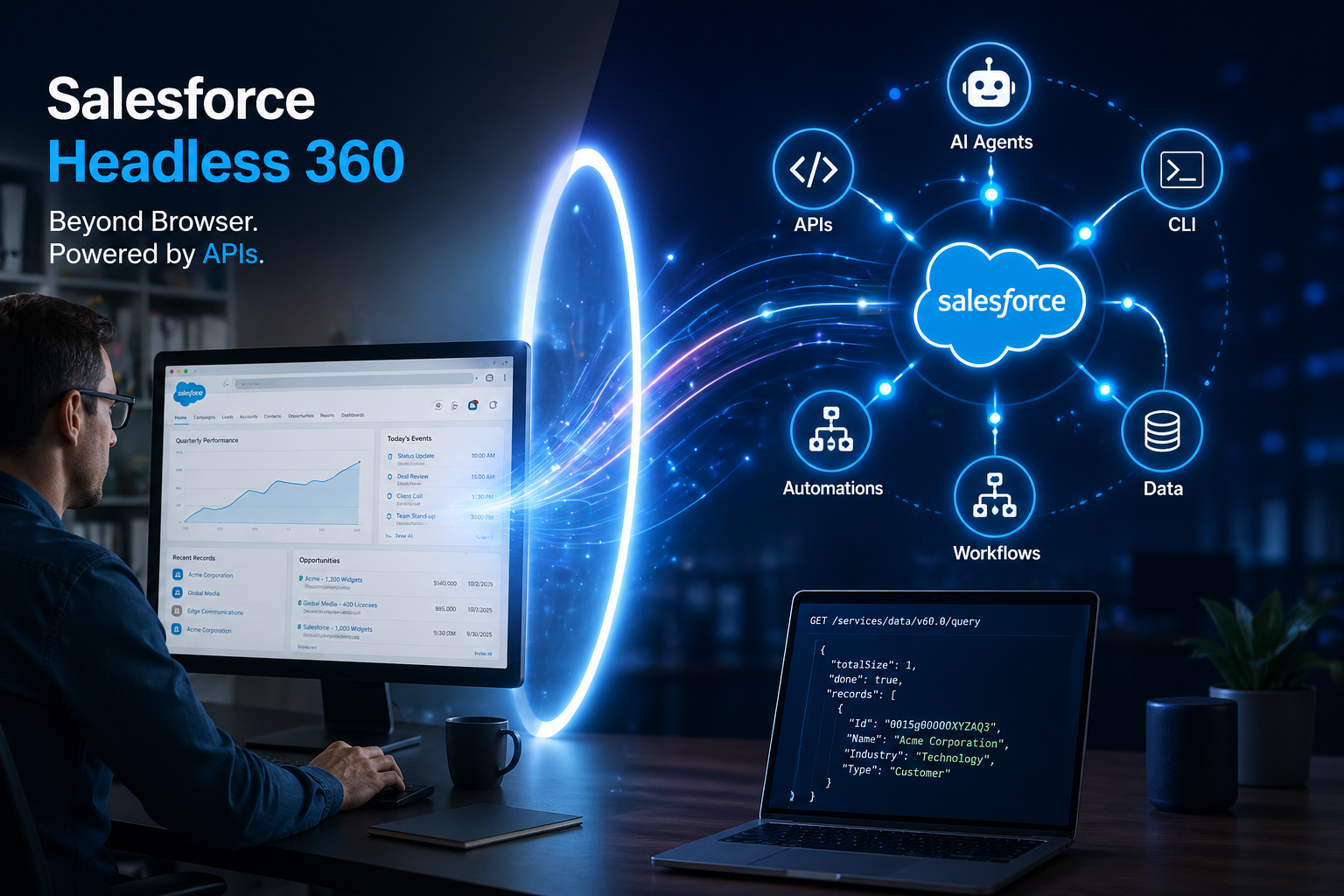
There’s a quiet but seismic shift happening in how enterprises interact with Salesforce, and most organizations haven’t fully grasped what it means for them yet.
For over two decades, “using Salesforce” meant exactly one thing: a human being opened a browser, navigated a UI, and clicked through screens to get work done. A sales rep updated a deal. A support agent escalated a ticket. A manager ran a report. Every action passed through a person and a screen.
That model is now being redesigned from the ground up.
In simple terms, Salesforce Headless 360 means every Salesforce capability data, logic, workflows; is now accessible via API or AI agent commands, without a human ever opening a browser. The premise is both simple and radical: everything in Salesforce is now accessible via an API, an MCP tool, or a CLI command, so AI agents, coding tools, and automated workflows can interact with your Salesforce environment without ever opening a browser.
What Does 'Headless' Mean in Salesforce Headless 360?
Before diving into what Salesforce Headless 360 delivers, it’s worth clarifying the concept.
In traditional web architecture, “headless” means decoupling the backend (data + logic) from the frontend (UI). A headless CMS, for example, serves content via API so developers can render it however they choose, in a mobile app, a smartwatch, or a kiosk.
Salesforce is applying this same principle to its entire platform ecosystem. But the twist here isn’t just about giving developers more flexibility with rendering. It’s about making the platform operable by AI agents that have no concept of a screen.
Agents don’t browse. They call. They invoke. They execute. And until now, most enterprise platforms, including Salesforce, have been fundamentally built for humans using mice and keyboards. Headless 360 changes that.
What Are the Three Core Features of Salesforce Headless 360?

1. Agent-Ready Development: MCP Tools and Coding Skills
The first major component addresses how developers build on Salesforce in an agentic world.
Salesforce has introduced over 60 new MCP (Model Context Protocol) tools and 30+ preconfigured coding skills that give AI coding agents direct, live access to your entire org, your data, your workflows, your business logic, right from within tools like Claude Code, Cursor, Windsurf, or Codex.
Think about what this means practically. A developer working in their preferred coding environment can now ask an AI assistant to query Salesforce data, trigger flows, or push deployment changes, without switching context, without logging into Setup, without manually navigating Workbench or the Developer Console.
The DevOps Center MCP takes this further by bringing programmatic access into CI/CD pipelines. Natural language commands replace the manual process of identifying what to deploy and when. According to Salesforce, MCP-connected developer workflows reduce deployment cycle times by up to 40%, a figure already being validated by enterprise teams running Agentforce in production
For teams that want full control over the visual layer, native React support now enables fully custom UI builds on top of the full Salesforce platform, any design system, and any interaction pattern, while still inheriting all the underlying data, security, and business logic.
2. The Experience Layer: Rich Interactions Beyond the Browser
The second innovation solves a problem that’s become increasingly urgent as enterprises distribute work across more communication channels: how do AI agents deliver meaningful interactions across platforms like Slack, WhatsApp, Voice, and Microsoft Teams?
Text alone doesn’t cut it for complex workflows. An agent that can only respond in plain text can’t render an approval card, display a data table, or walk a user through a rebooking workflow.
The Agentforce Experience Layer separates what an agent does from how it appears. It functions as a UI service that lets agents generate rich, interactive components, decision tiles, status cards, form flows, and data layouts that render natively inside whatever surface the user is already working in.
Built once, these components render across Slack, Mobile, ChatGPT, Claude, Gemini, Teams, or any MCP-compatible client. The agent handles the logic; the Experience Layer handles the presentation.
This matters especially in Slack, where Salesforce reports that custom AI agent deployments have grown 300% since January 2026. Slackbot is fast becoming the primary interface through which employees interact with enterprise AI, and the Experience Layer ensures those interactions can be as rich and action-oriented as any native app.
At BugendaiTech, our Agentforce implementation teams are already seeing clients move from scoping to production in under three weeks using Headless 360's MCP tooling a timeline that would have been impossible under traditional Salesforce development approaches
3. Production-Grade Trust and Observability Controls
Shipping an agent is straightforward. Ensuring that an agent behaves correctly and consistently across thousands of edge cases, six months after go-live, is where most enterprise AI initiatives struggle.
Salesforce has built an entirely new set of governance tools to address this, and they’re arguably the most underappreciated part of the Headless 360 announcement.

For enterprises running agents across multiple vendors and platforms, Agent Fabric brings everything under a single, governed control plane and centralized governance for agents, tools, and LLMs, regardless of the underlying models powering them.
Why Does Platform Context Matter More Than AI Model Alone?
A fair question surfaces here: if AI models are already powerful, and agents can call any API, why does it matter which platform they’re built on?
Because a model is just inference. Inference without context is expensive guesswork.
An AI agent connected to a raw database doesn’t know that a particular customer has a breach of their support SLA, a renewal due in 28 days, an open escalation from their CFO, and a relationship owner who has a long-standing personal connection to that account. That context took years to accumulate. It lives in Salesforce, in Data 360, in Customer 360, in the relationships, custom fields, and workflow rules your team built over time.
Salesforce Headless 360 exposes all of that via an API or an MCP tool, so your agents can access it from any surface without touching a UI. The difference between an agent that writes code and an agent that understands your business comes down to what it has access to.
This is how Salesforce frames the four layers that compound on each other:
| Layer | What It Does |
|---|---|
| System of Context (Data 360) | Unified, real-time business data ready for agents to act on |
| System of Work (Customer 360) | Decades of workflow logic across sales, service, and operations |
|
System of Agency (Agentforce) |
Build, deploy, and manage agents at scale across every channel |
|
System of Engagement (Slack) |
The interface where humans and agents collaborate |
Each layer is valuable alone. Together, they’re a compound advantage that’s extraordinarily difficult to replicate from scratch.
What Results Are Enterprises Seeing from Salesforce Headless 360?
The business outcomes from organizations already operating on this architecture are worth noting.
Engine, a corporate travel platform, deployed production-ready AI agents in 12 days and reported millions in savings alongside significant gains in technical velocity, handling complex service needs at scale without adding operational complexity.
Indeed, the global employment marketplace used Agentforce to give coding agents live access to their Salesforce environment from within the tools developers already use. The result: faster movement from idea to production, with cleaner separation between experimentation and delivery.
Grupo Globo’s development team uses Agentforce Vibes for repetitive, time-consuming Salesforce tasks, metadata updates, boilerplate code generation, and pre-deployment checks, reducing manual overhead and accelerating delivery cycles.
What This Means for Salesforce Customers and Partners
If your organization runs Salesforce, Headless 360 represents a meaningful strategic opportunity, but also a reason to reassess assumptions about how you’ve structured your Salesforce practice.
For IT and Architecture Teams: The platform is now designed to be invoked programmatically rather than navigated manually. Infrastructure, integration patterns, and governance frameworks need to account for agent-to-platform interactions alongside human ones.
For Development Teams: The coding experience is fundamentally different. With MCP tools available in your IDE and coding agent, Salesforce development is no longer context-switching between a browser and a code editor. This should accelerate delivery and reduce the cognitive overhead that slows most Salesforce development teams.
For Operations and Business Leaders: The agents you deploy today are the first iteration. The Headless 360 governance tools, scoring evals, session tracing, and A/B testing are what allow you to improve them over time with real data rather than intuition.
Is Salesforce Headless 360 Right for Your Organization?
Salesforce Headless 360 isn’t a feature release. It’s a platform philosophy, a declaration that the screen is no longer the only way in.
For enterprises serious about building agent-driven operations, this matters. The value of a platform isn’t just in what it knows, but in how accessible that knowledge is to the systems and agents that need to act on it. Salesforce has just made its entire knowledge base, 25 years of business logic, workflows, data, and trust infrastructure, available to any agent who knows how to ask.
The question for your organization isn’t whether to pay attention to this; it's how. It’s about having the right partner to help you move from awareness to execution.

BugendaiTech is a Salesforce consulting and implementation partner specializing in Agentforce deployments, Salesforce architecture, and enterprise AI integration. If you’re exploring what Salesforce Headless 360 means for your organization, talk to our experts and you can also explore our latest industry updates and event highlights in the News section, including BugendaiTech at TDX26.